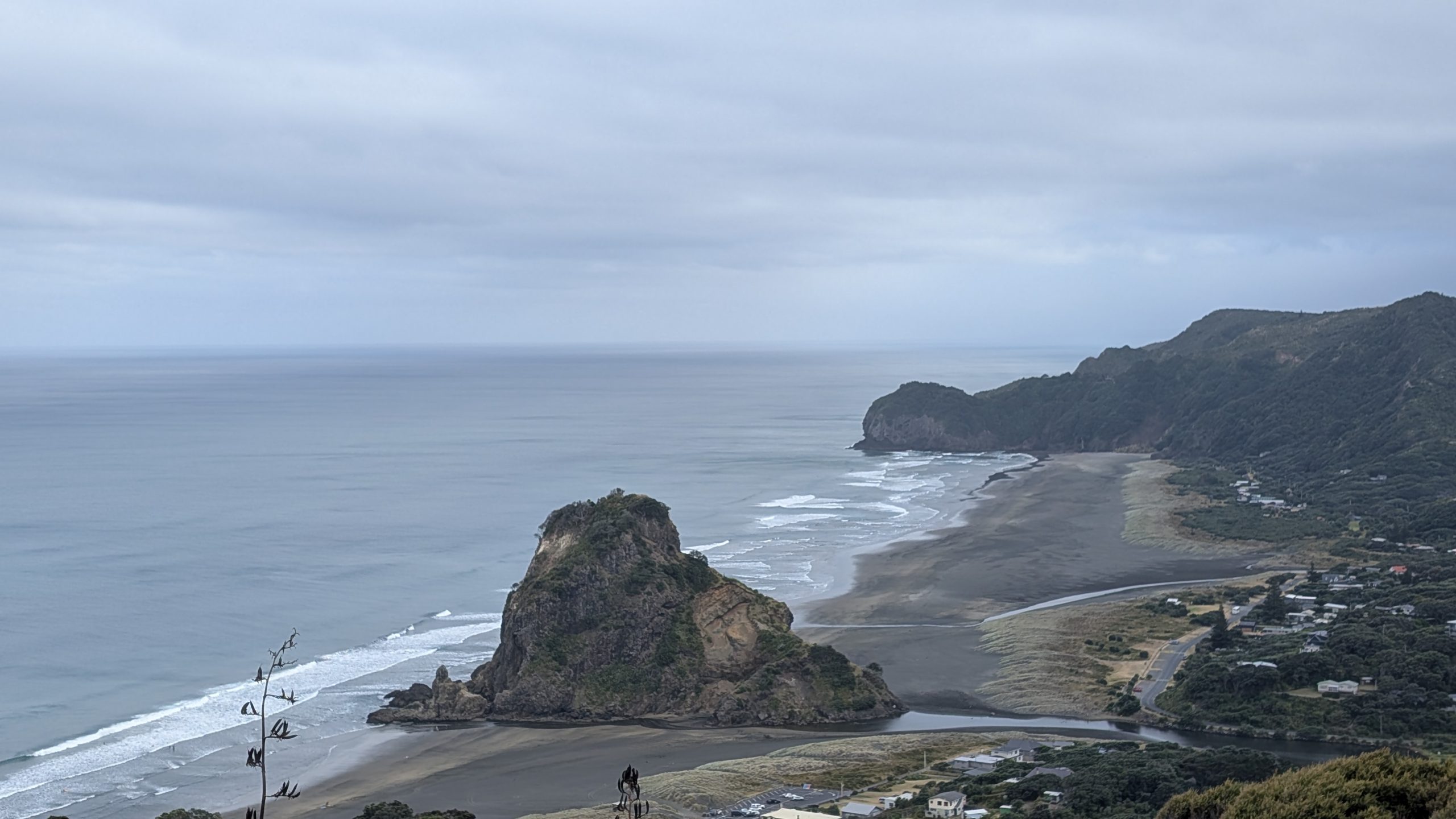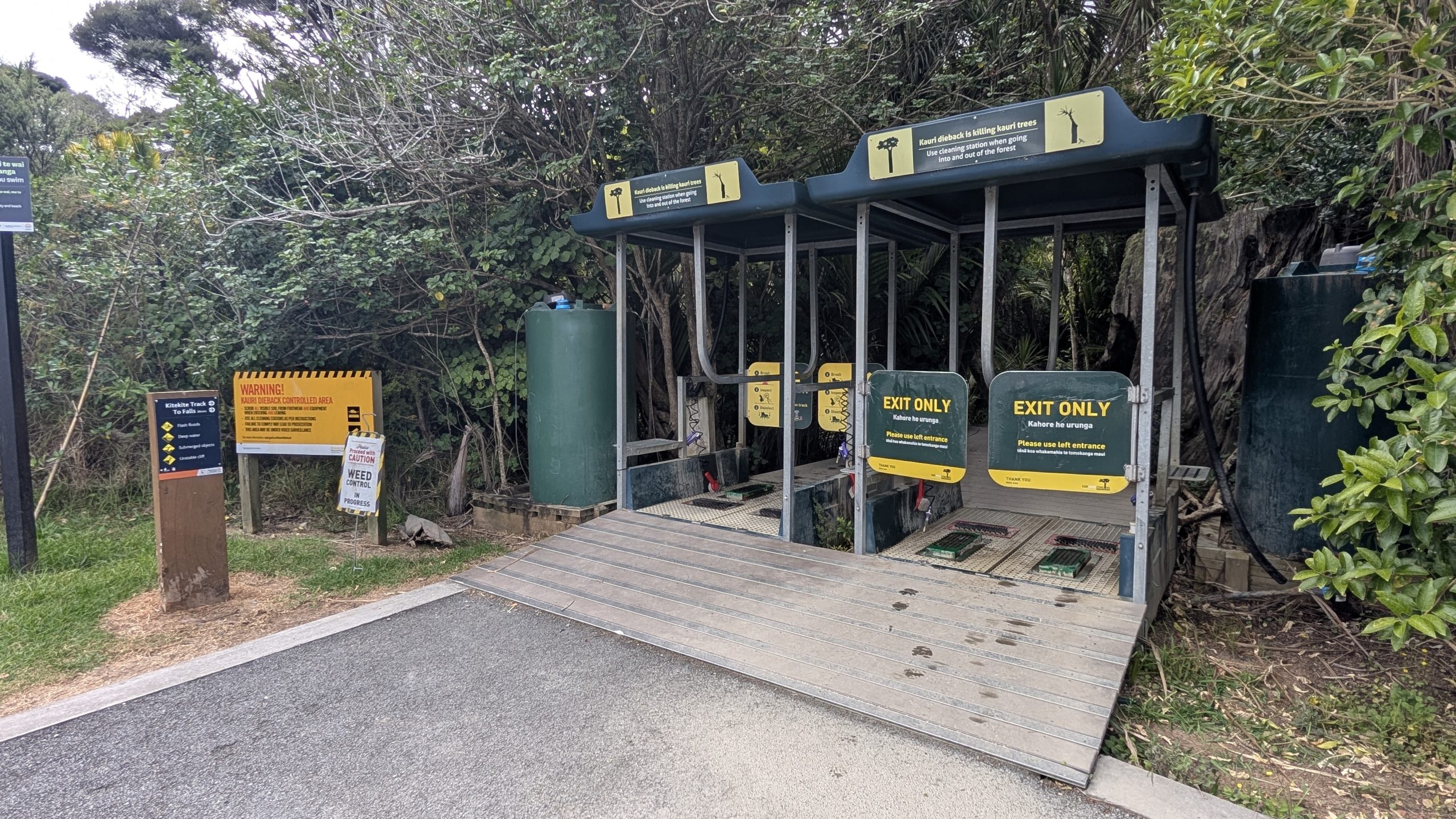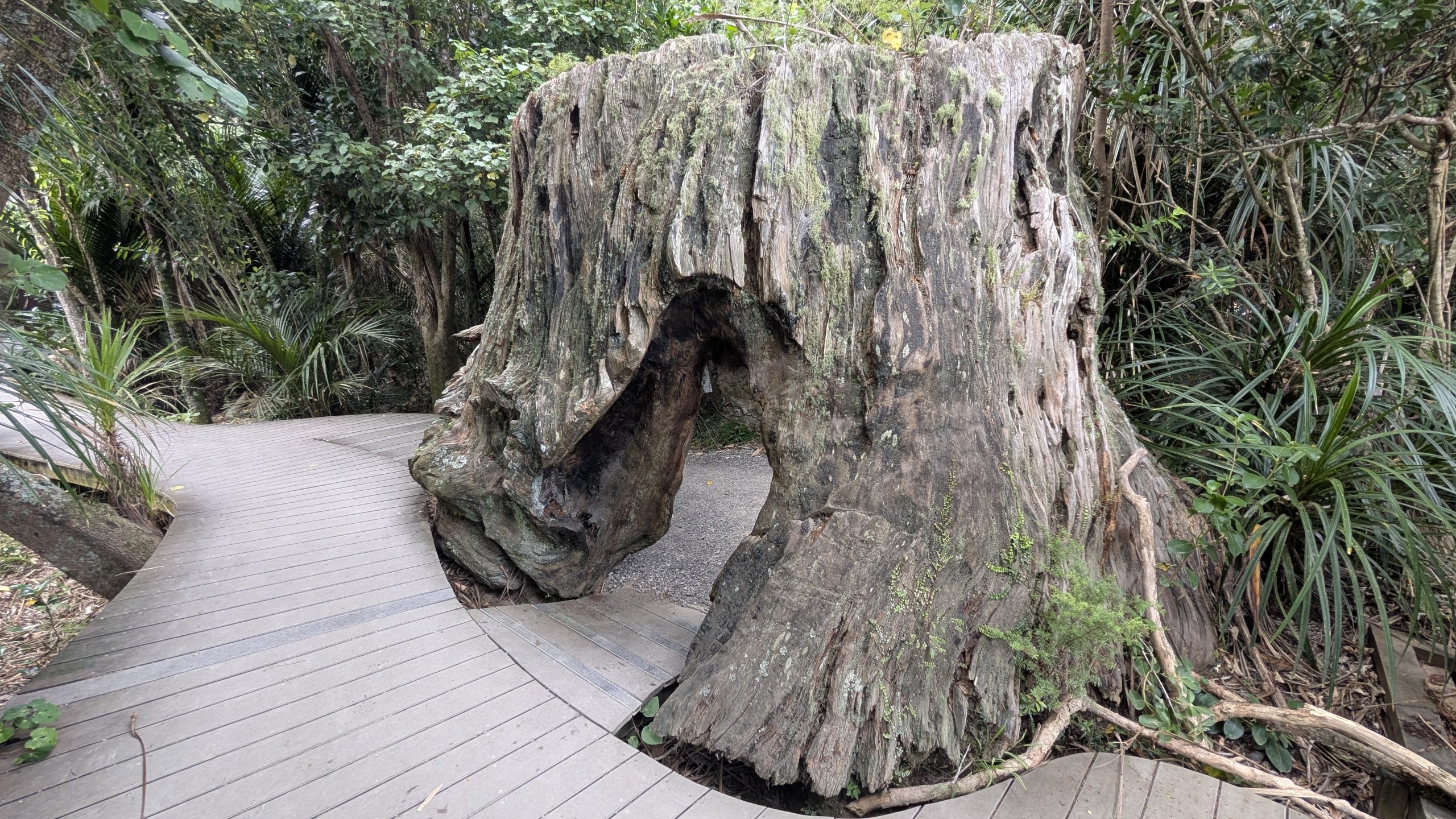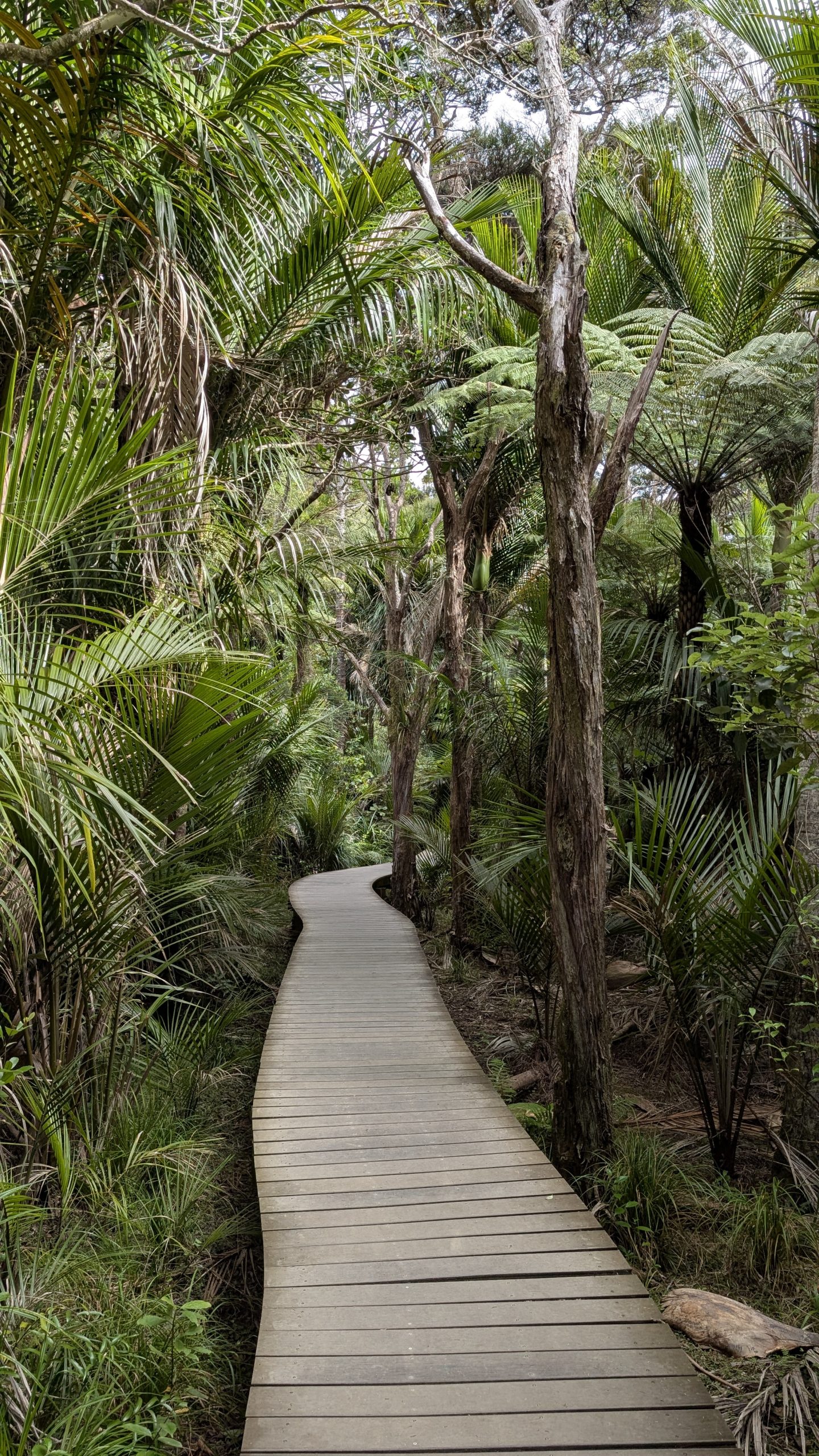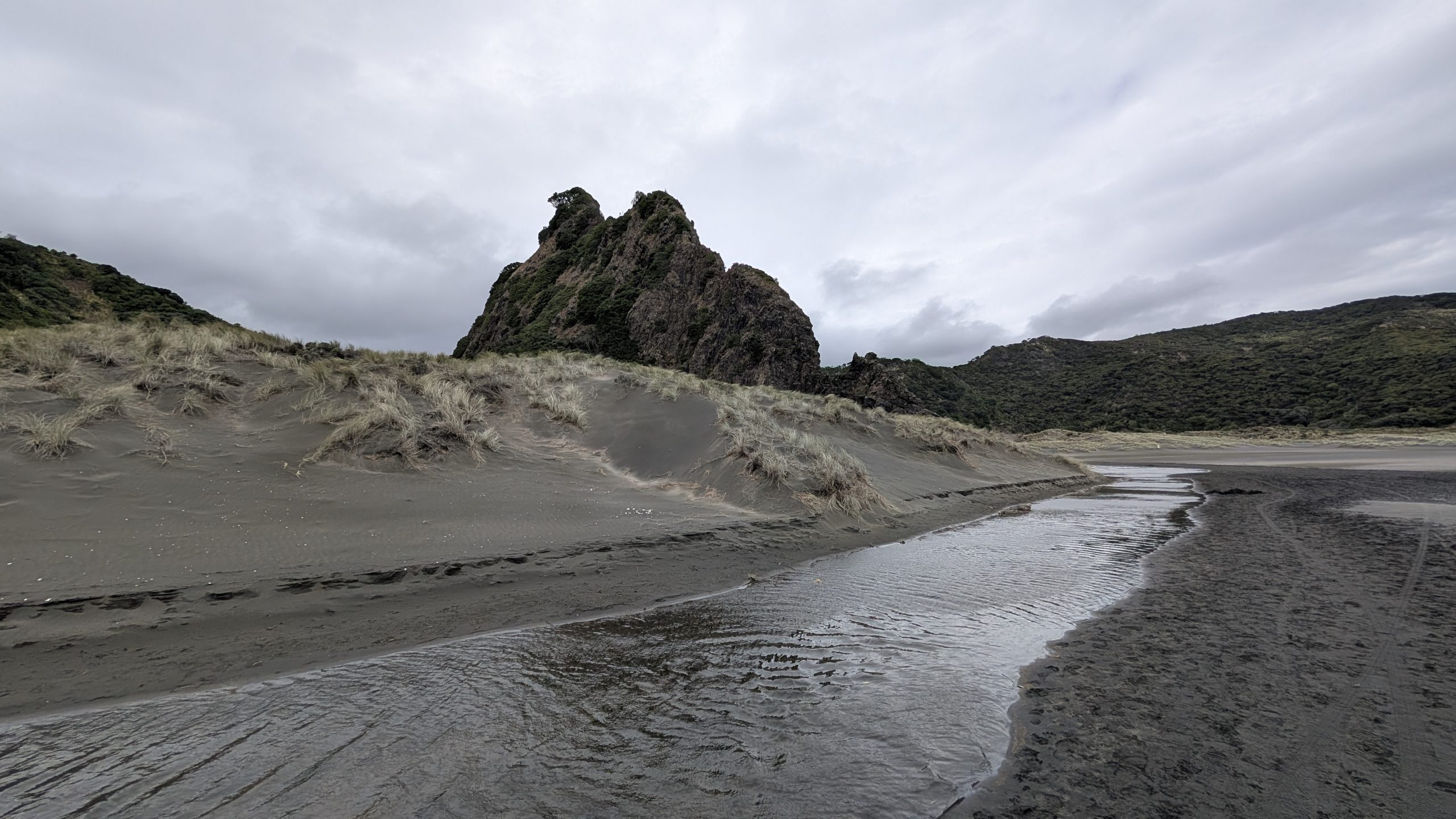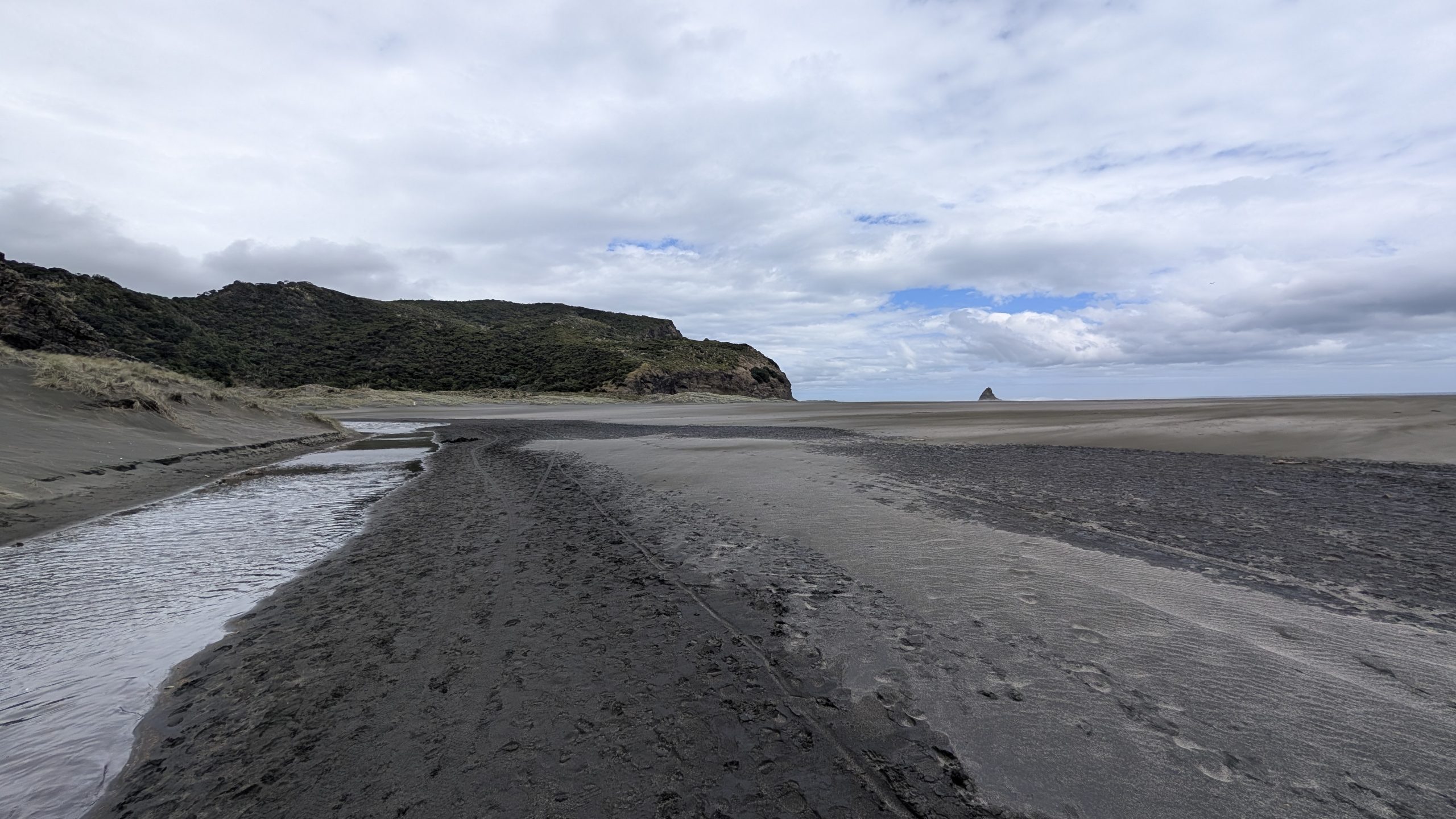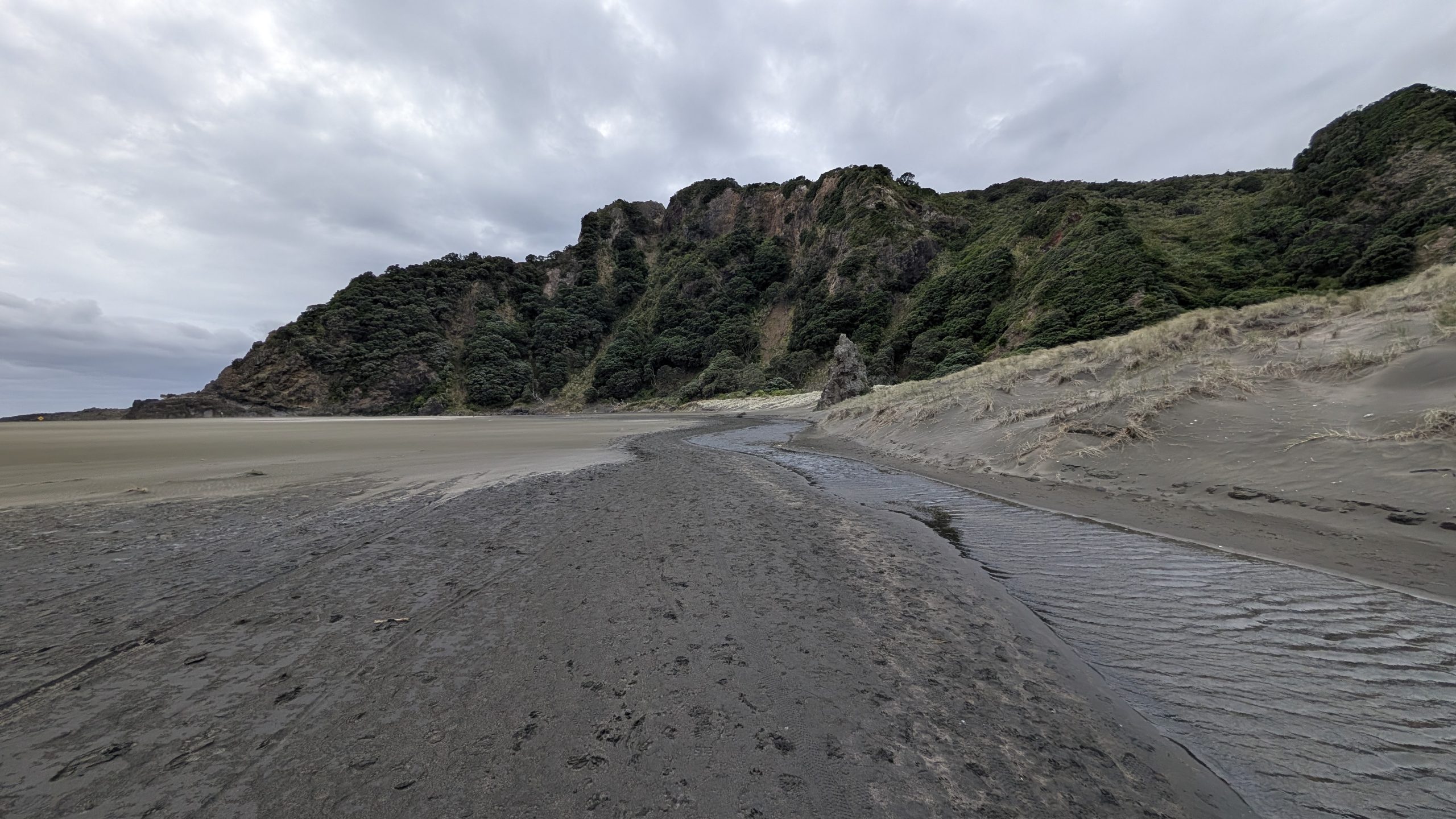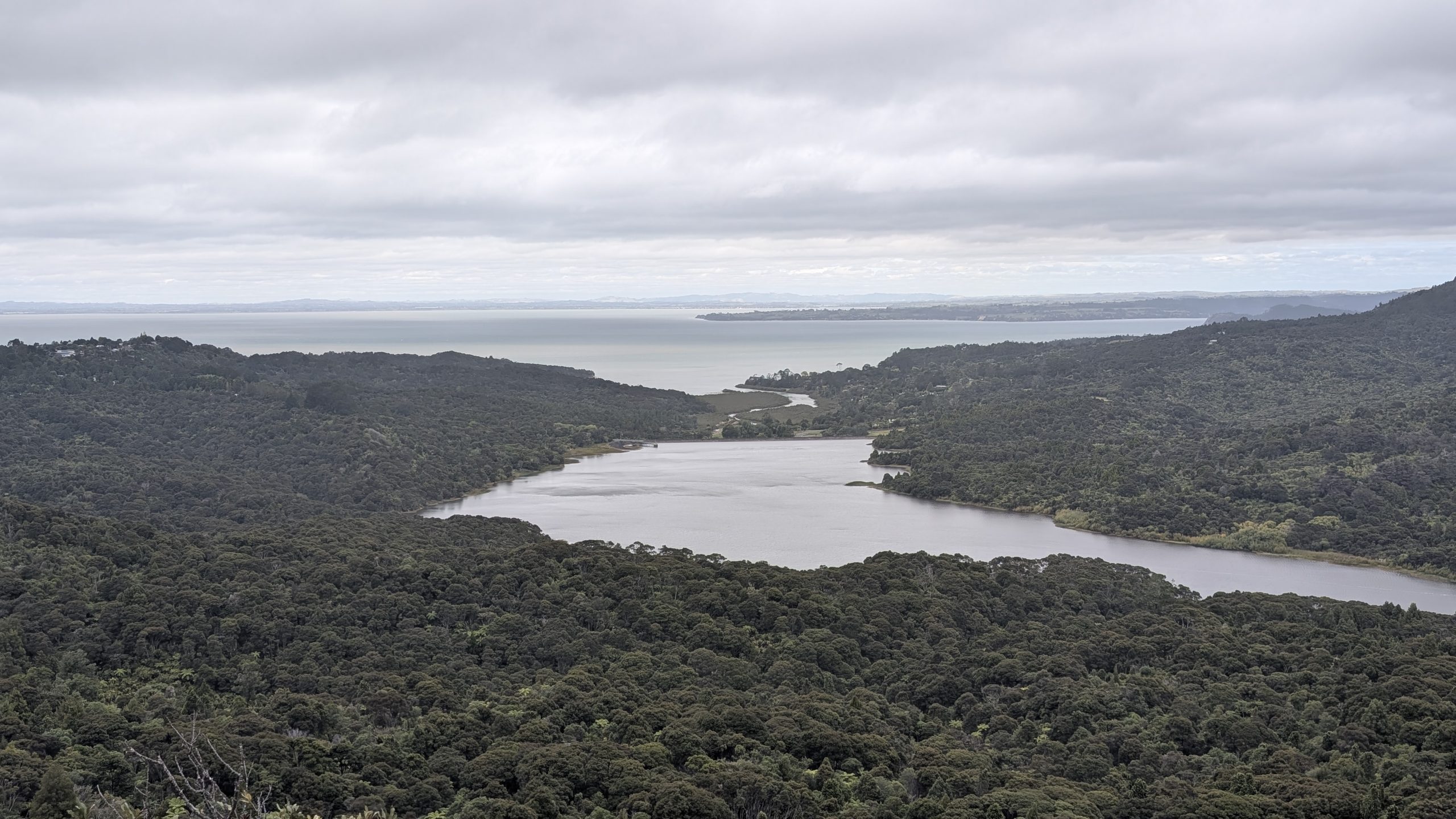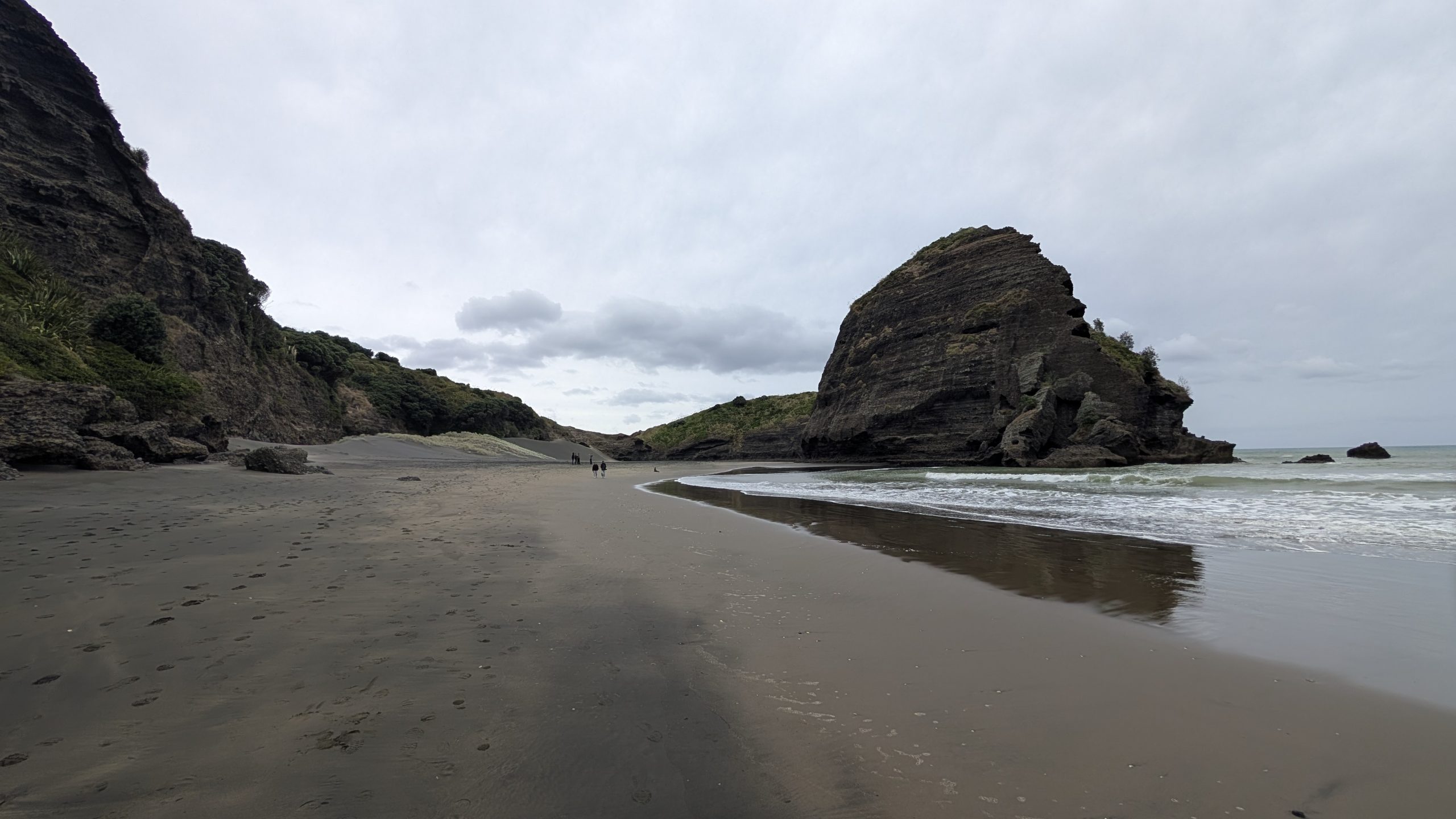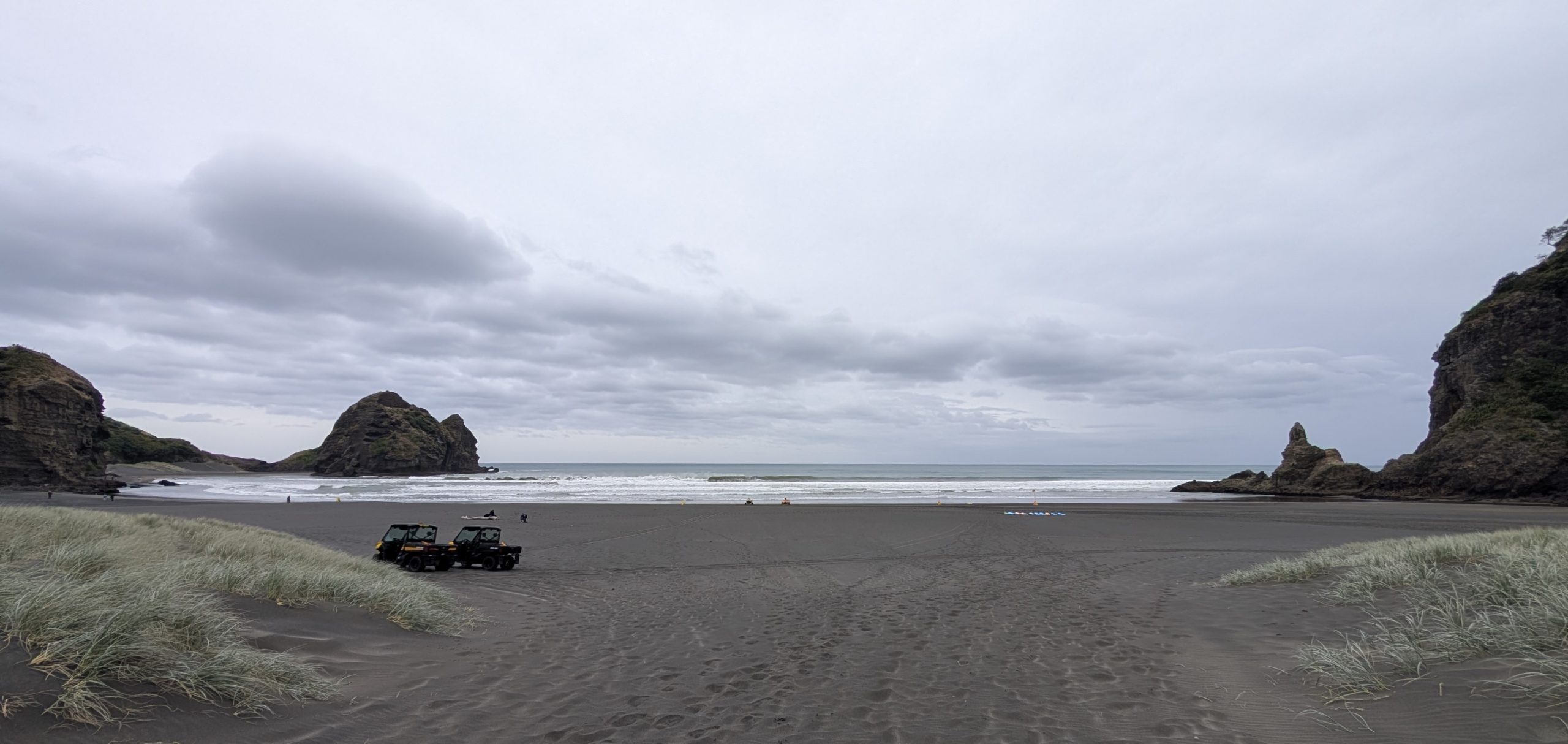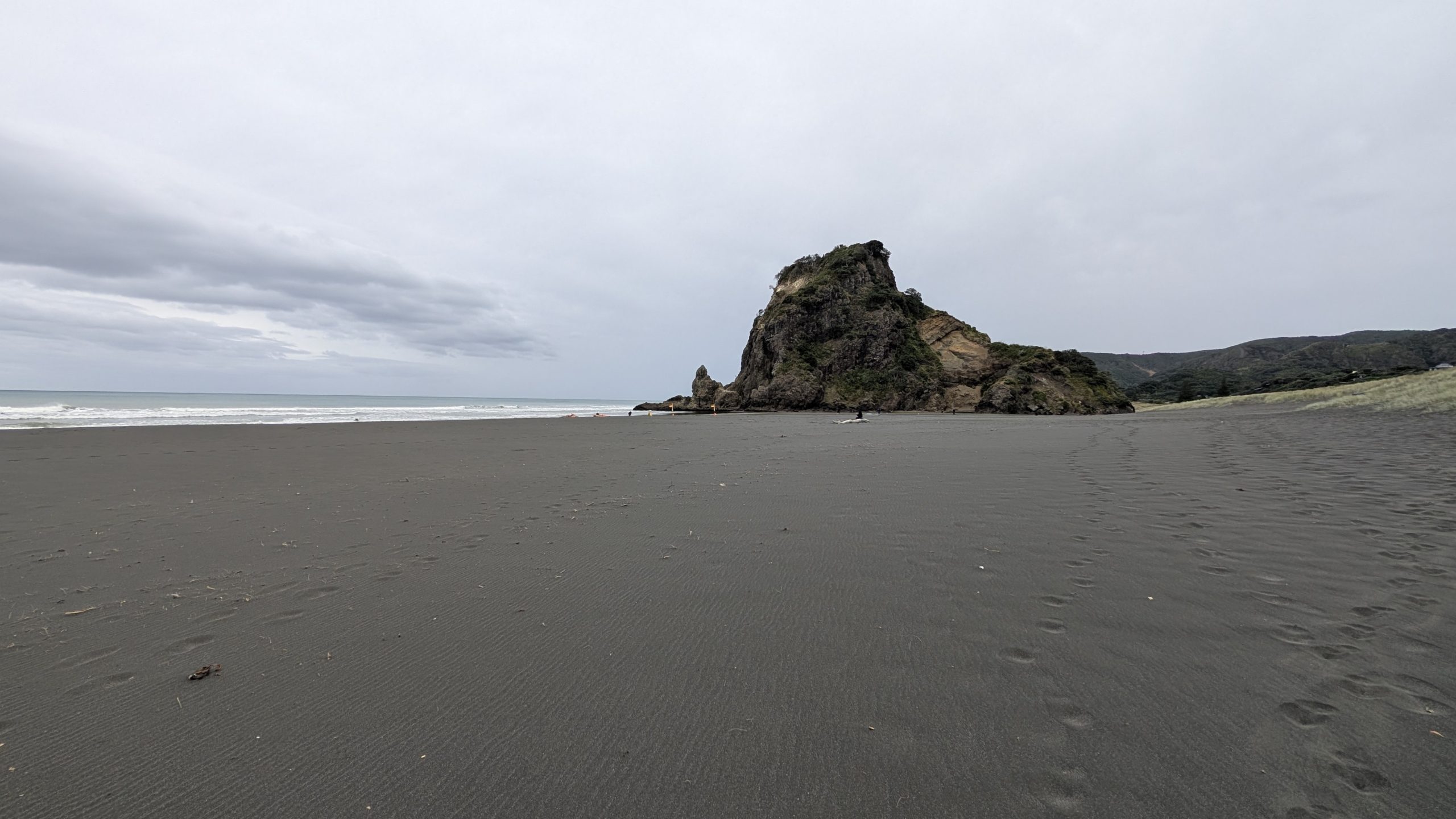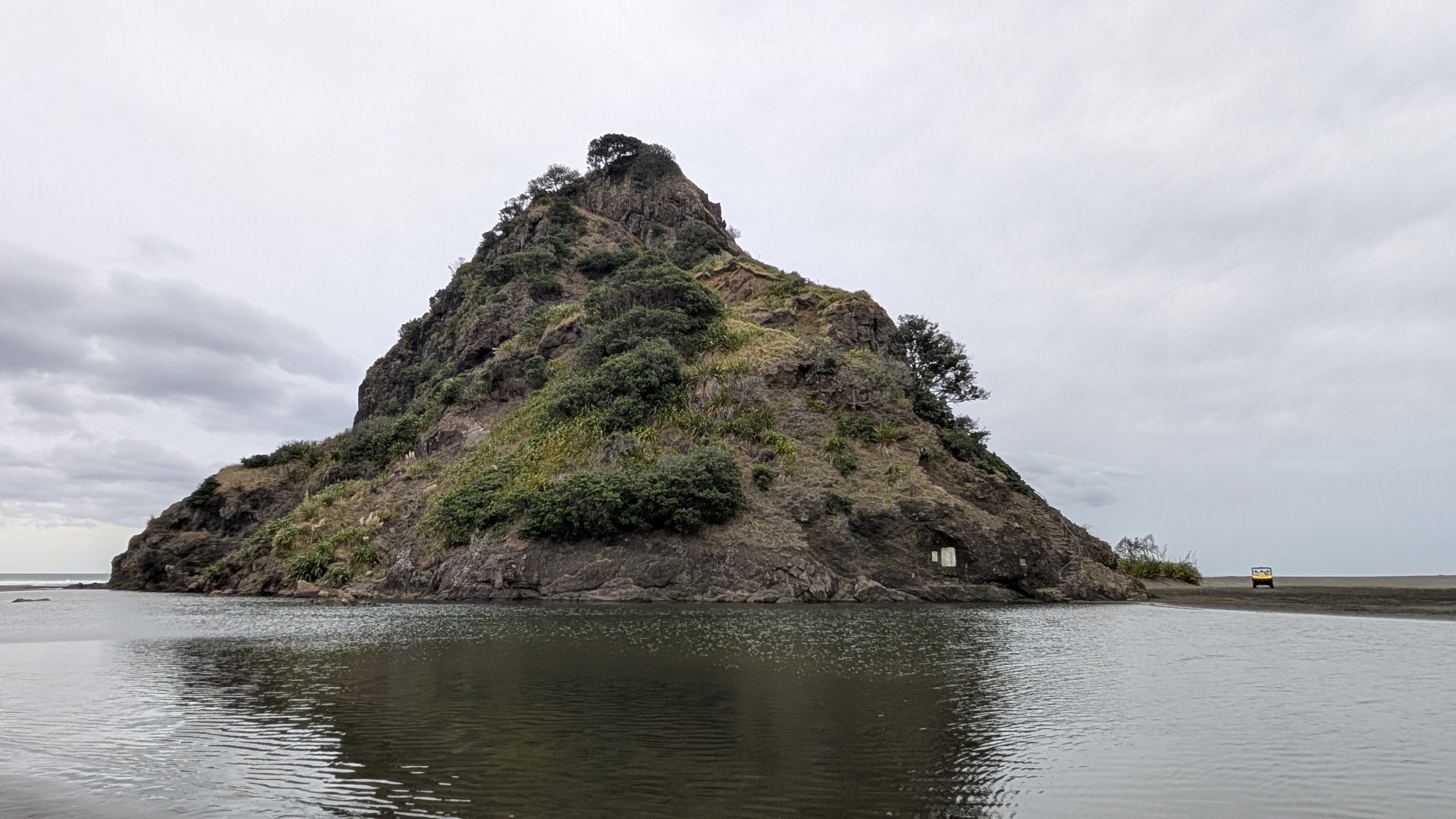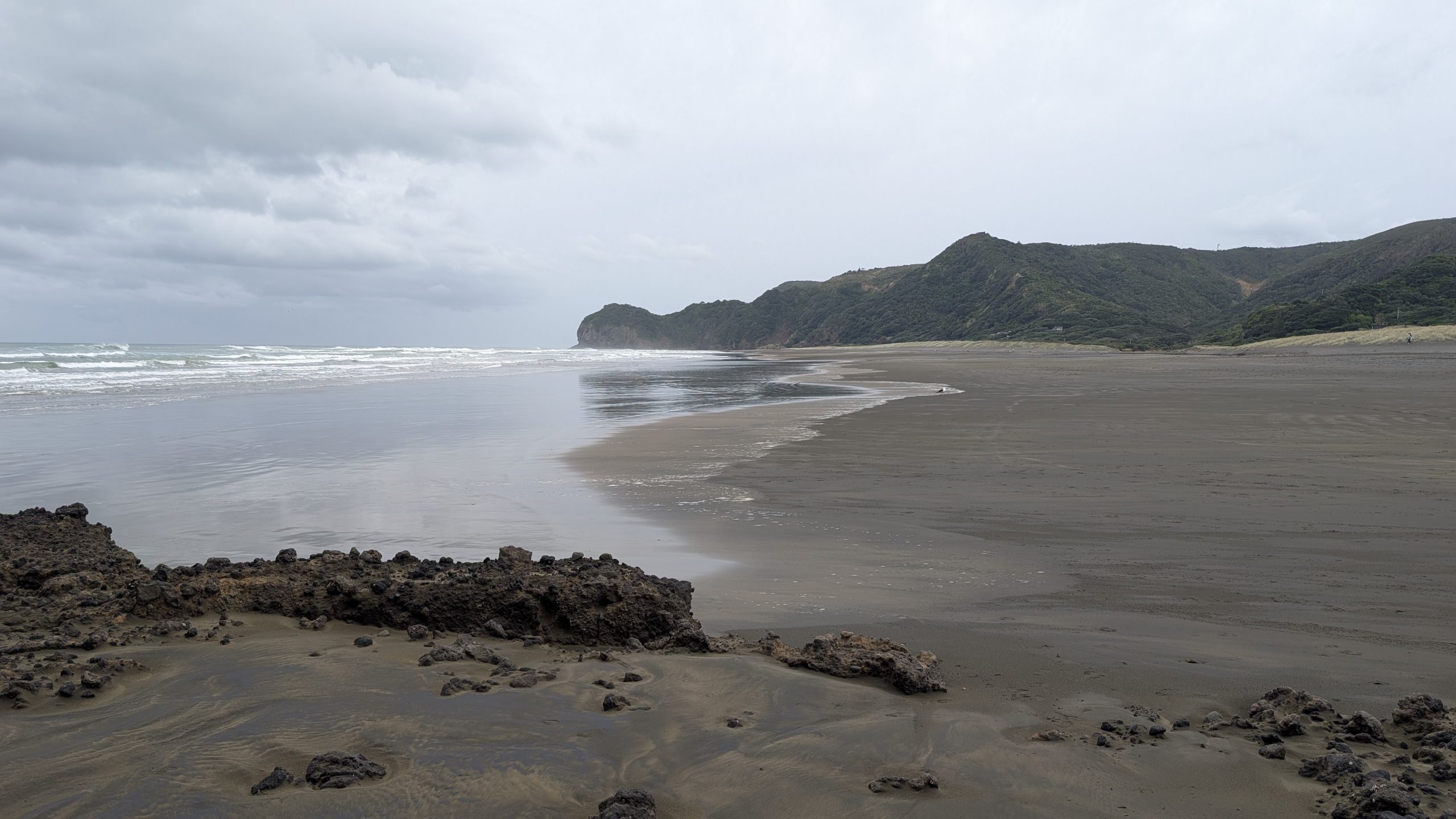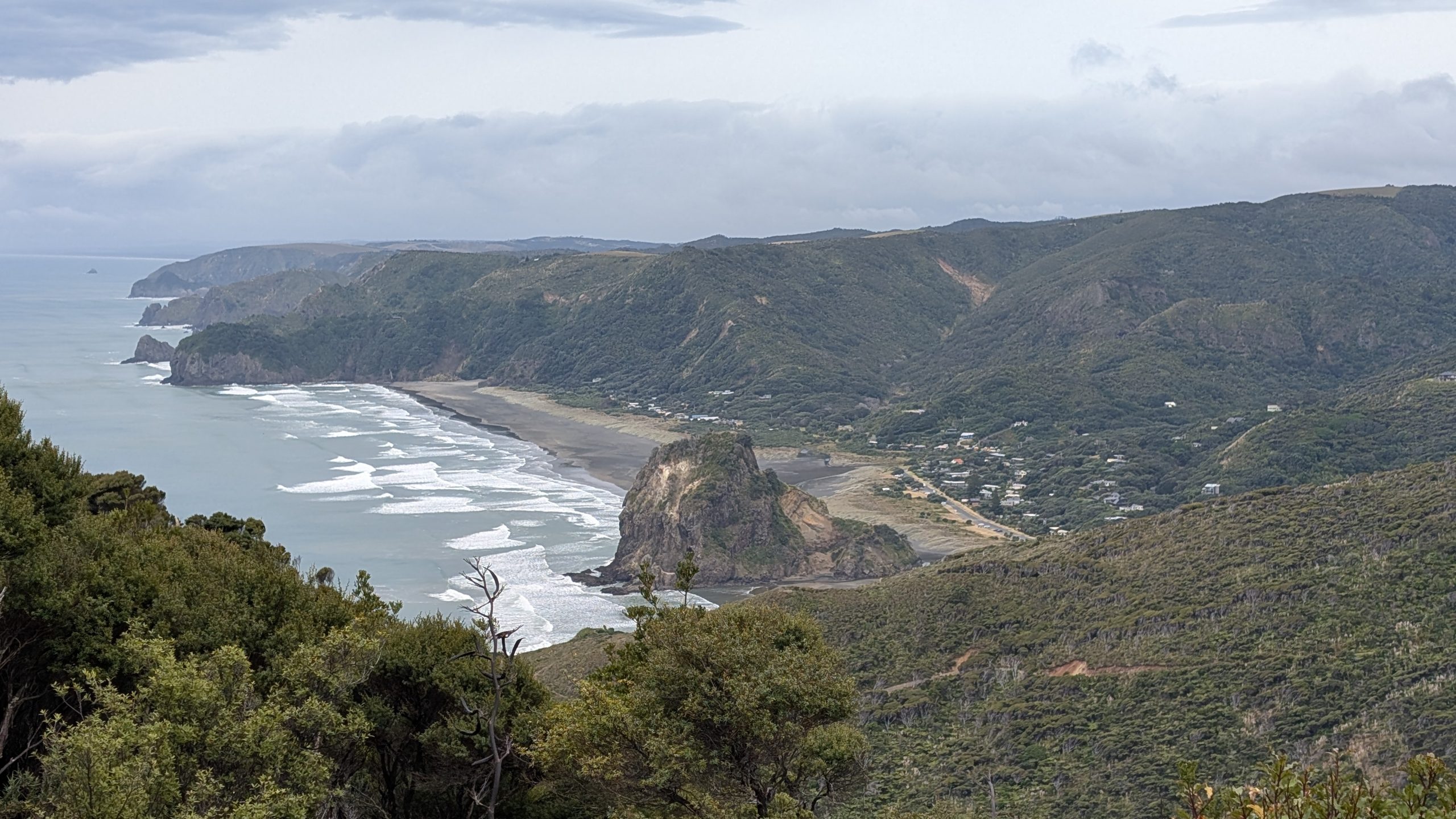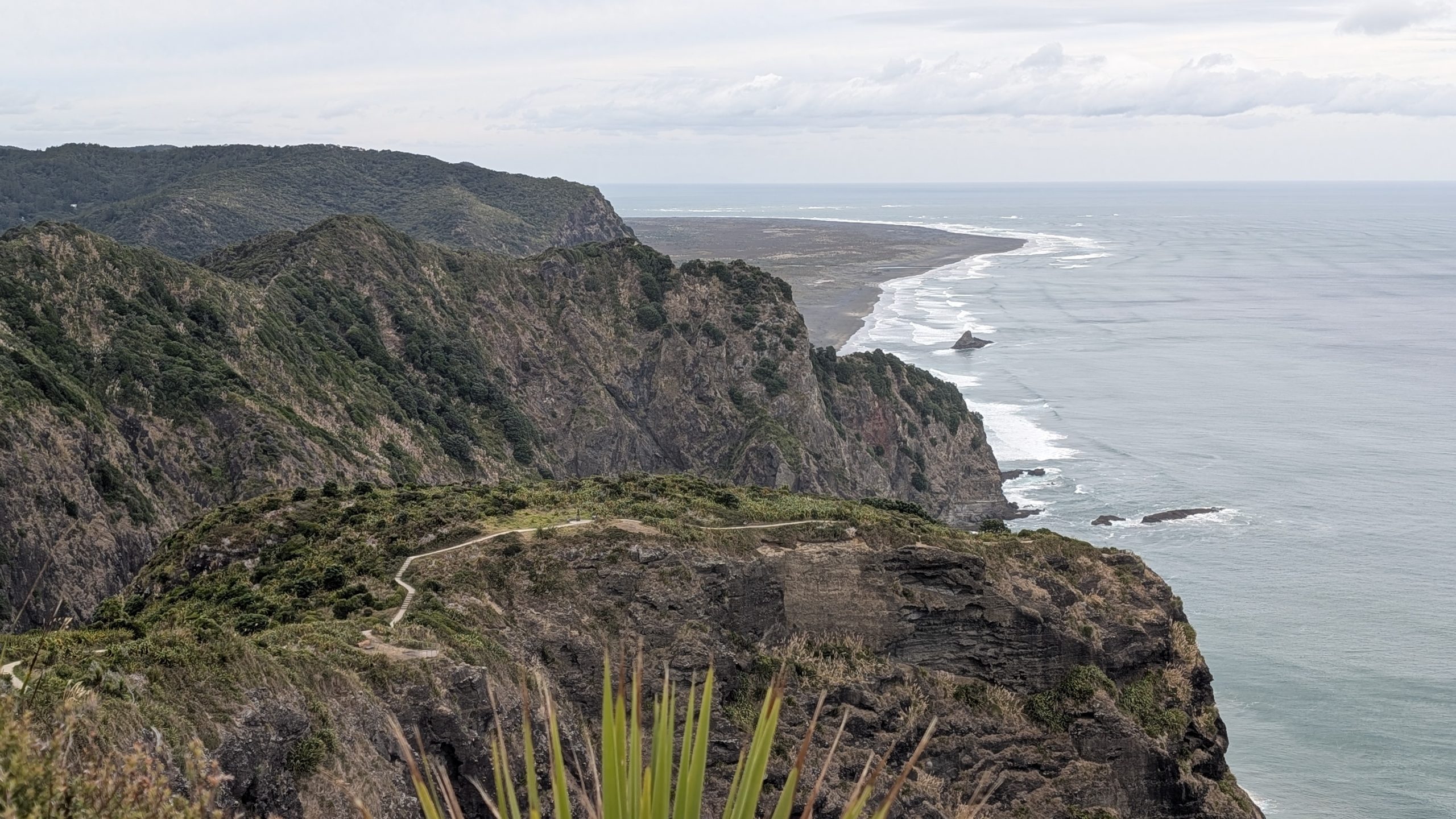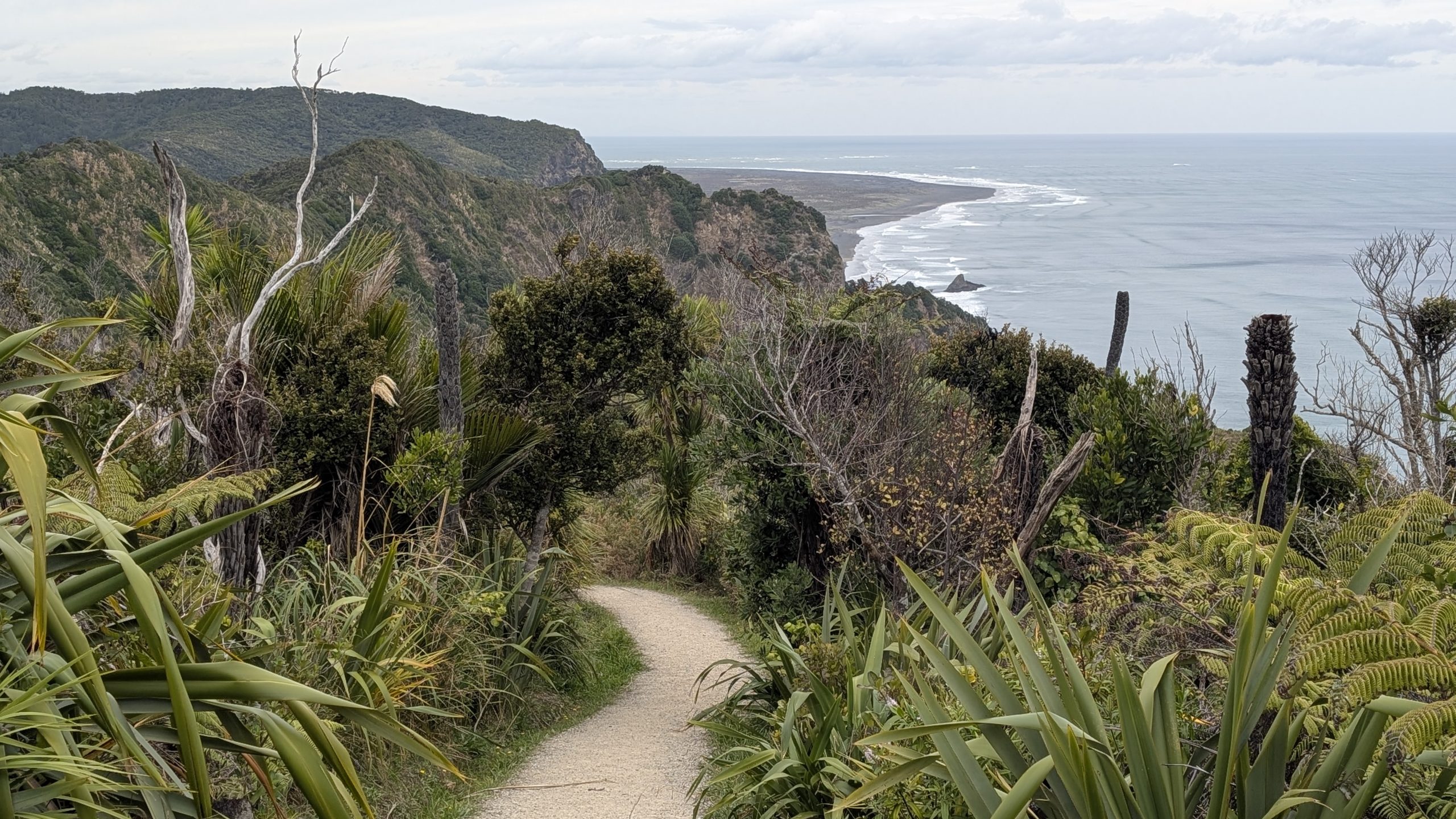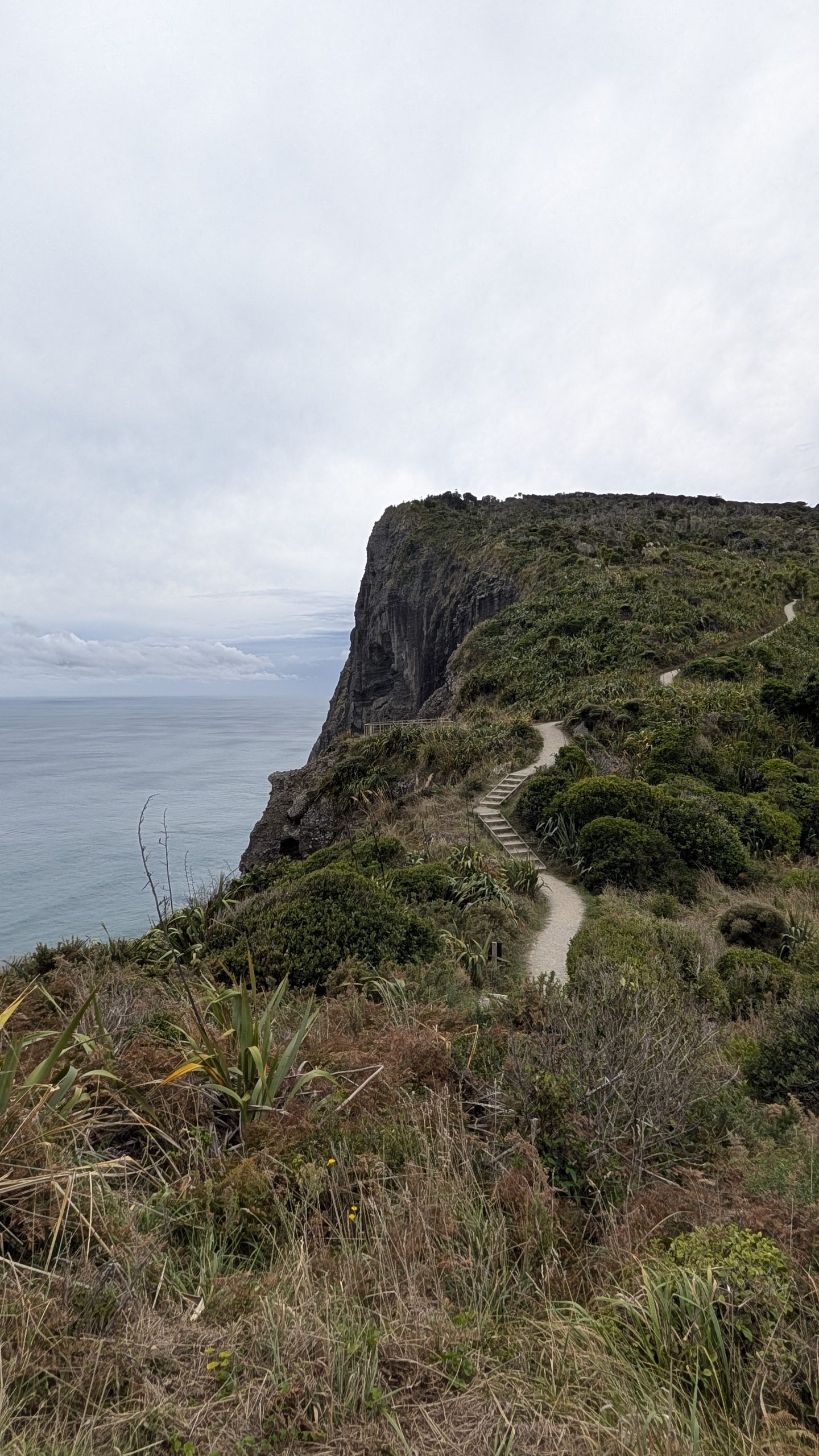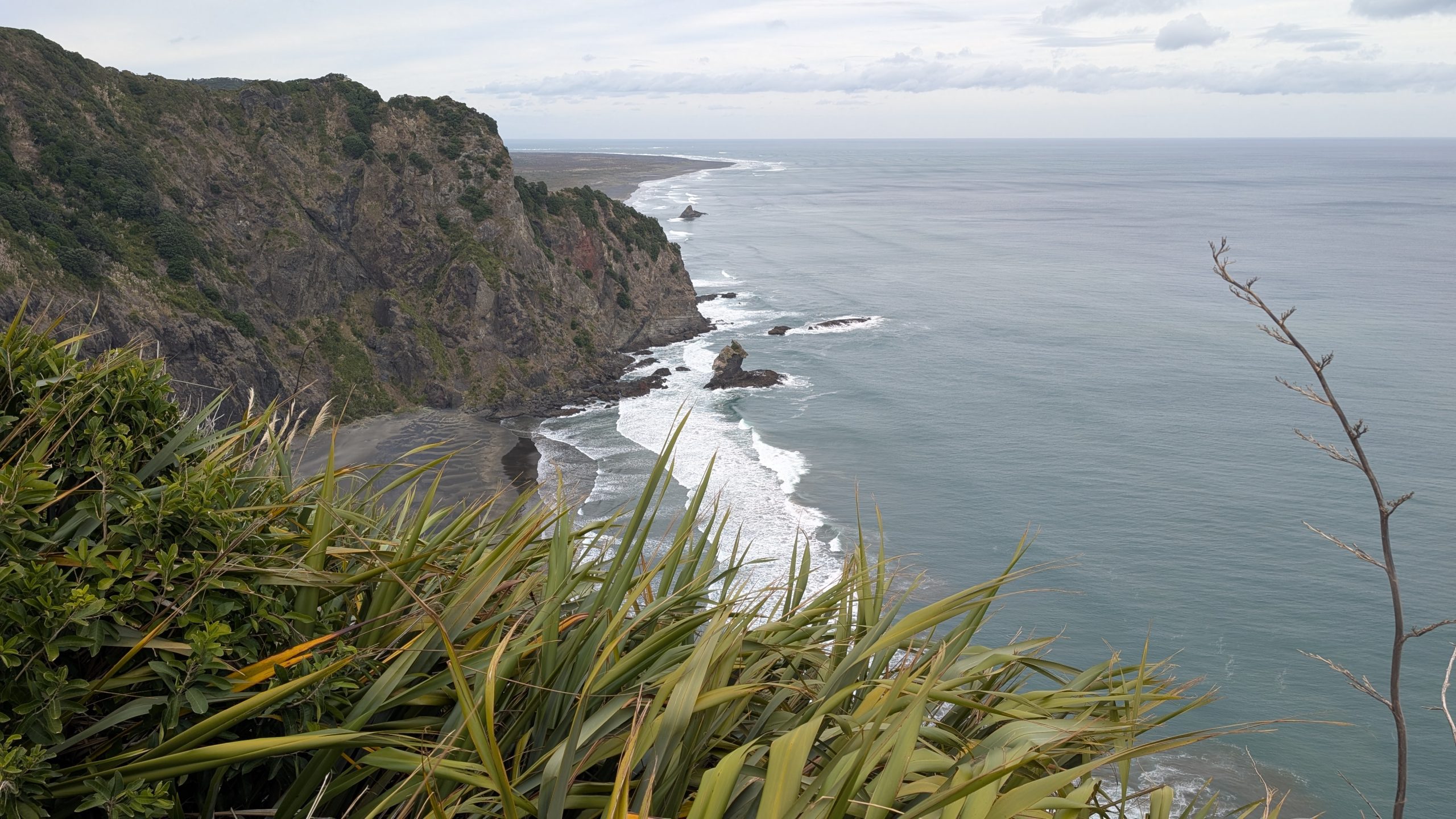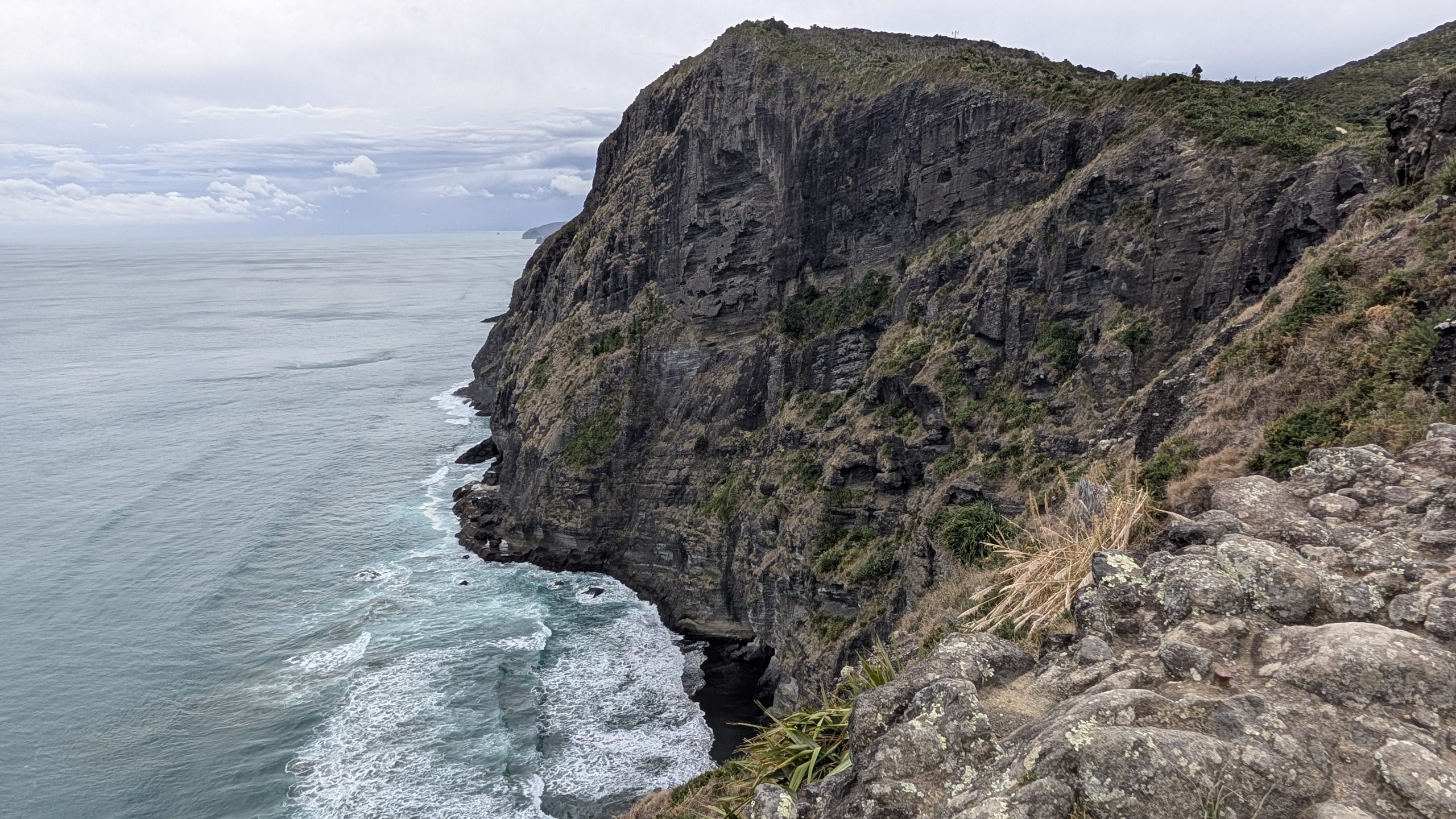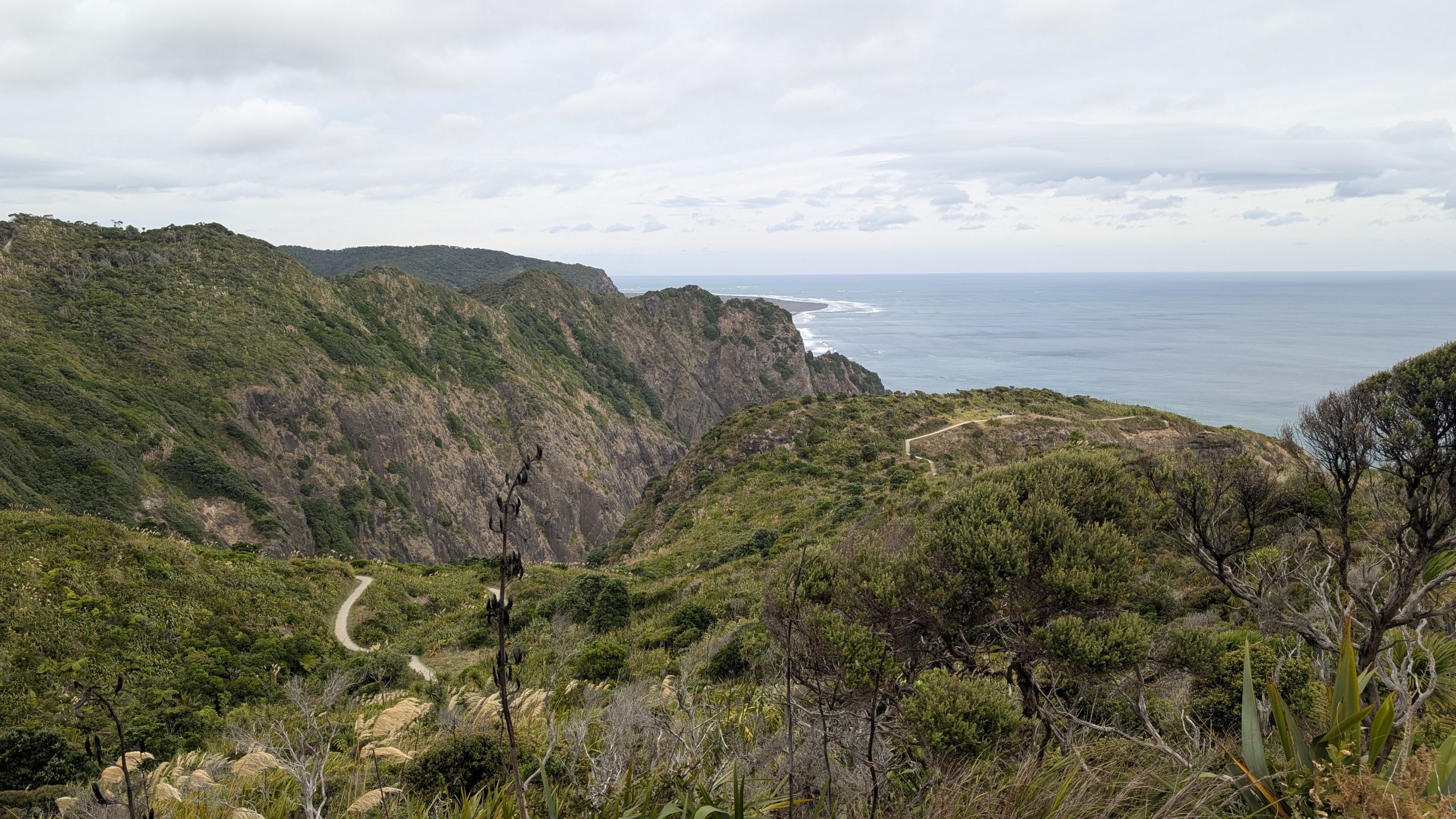
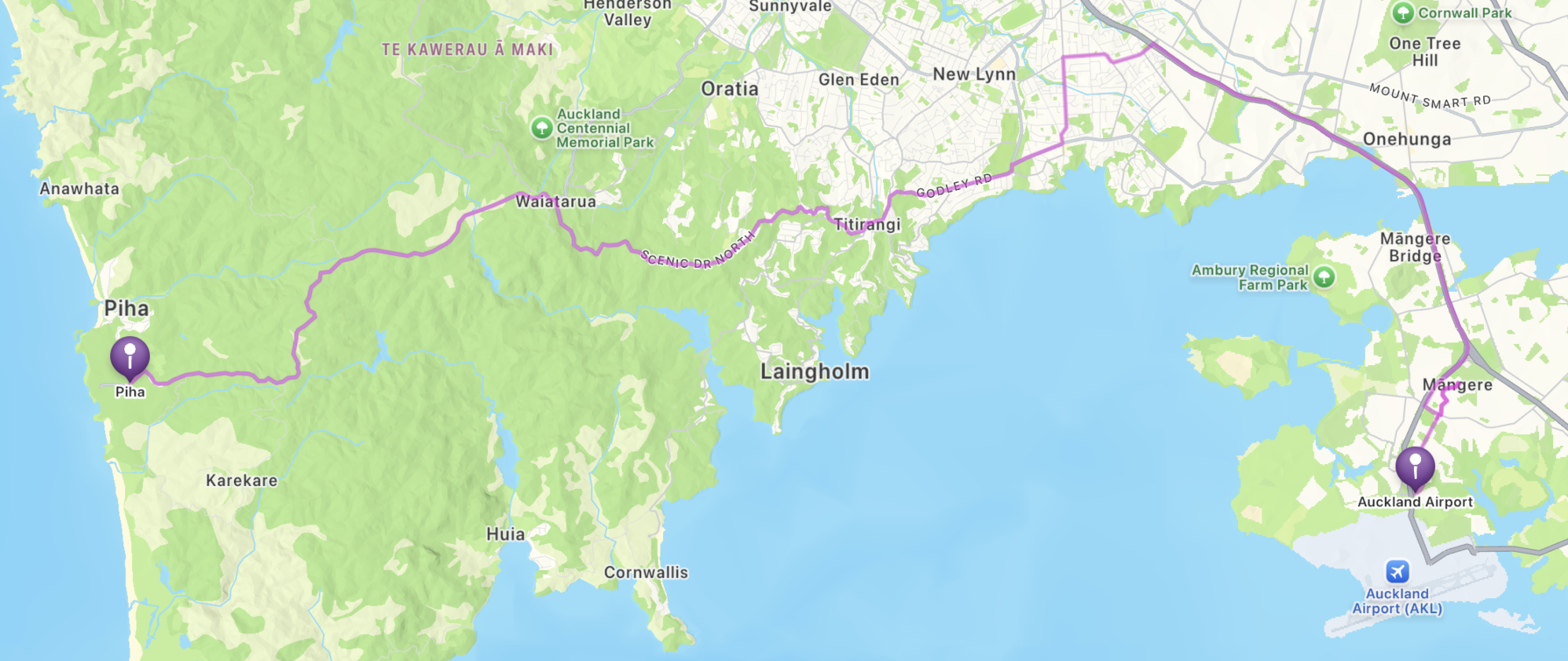
We woke up to a gorgeous weather day with clear blue skies. Our itinerary for the day was to make the round trip drive up north to Port Jackson to the end of the road at Fletcher Bay. The road was 25 km of gravel starting at Colville. The road was mostly well graded, but it was narrow and very twisty in spots, making it a bit challenging to navigate around other vehicles. Fortunately we did not pass many other vehicles on this road.
There was road construction near the beginning of the gravel stretch that delayed us by at least 20 minutes. We drove nonstop to the end of the road since we were running short on time: we had planned to hike the Coromandel Walkway to the lookout, which was about a 3-hour round trip hike.
The Coromandel Walkway was billed as one of the most scenic hikes on the North Island, with lots of stunning coastal views. I was really looking forward to it. But when we arrived at the trailhead, we found this:
Oops!
So that substantially changed the rest of our day. Oh well, we had been running short of time anyway... I subsequently found out that the trail was closed on January 24, which was right after we had arrived in New Zealand. There was no way I would have known about it unless I had thought to check its status online after we arrived.
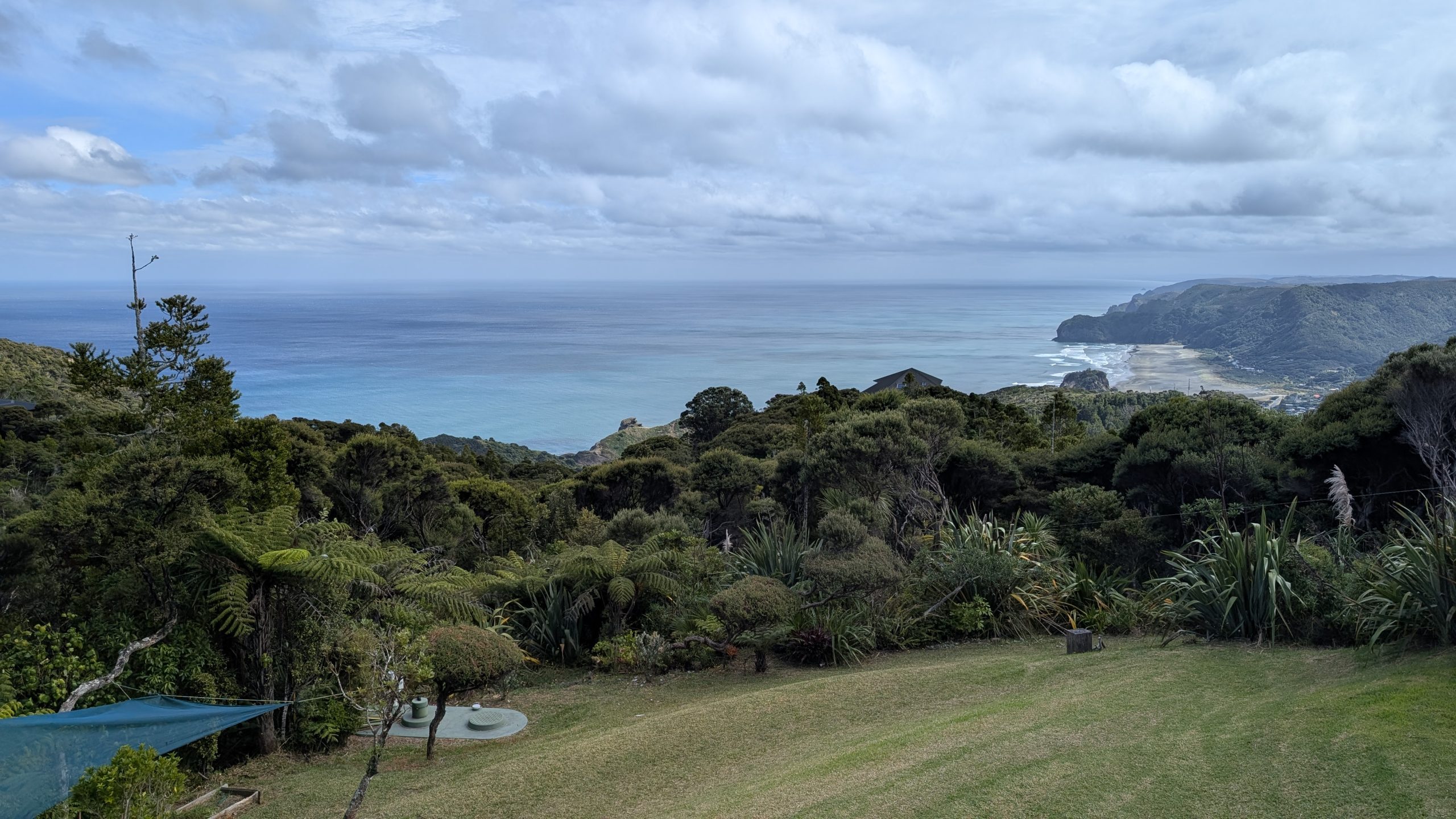
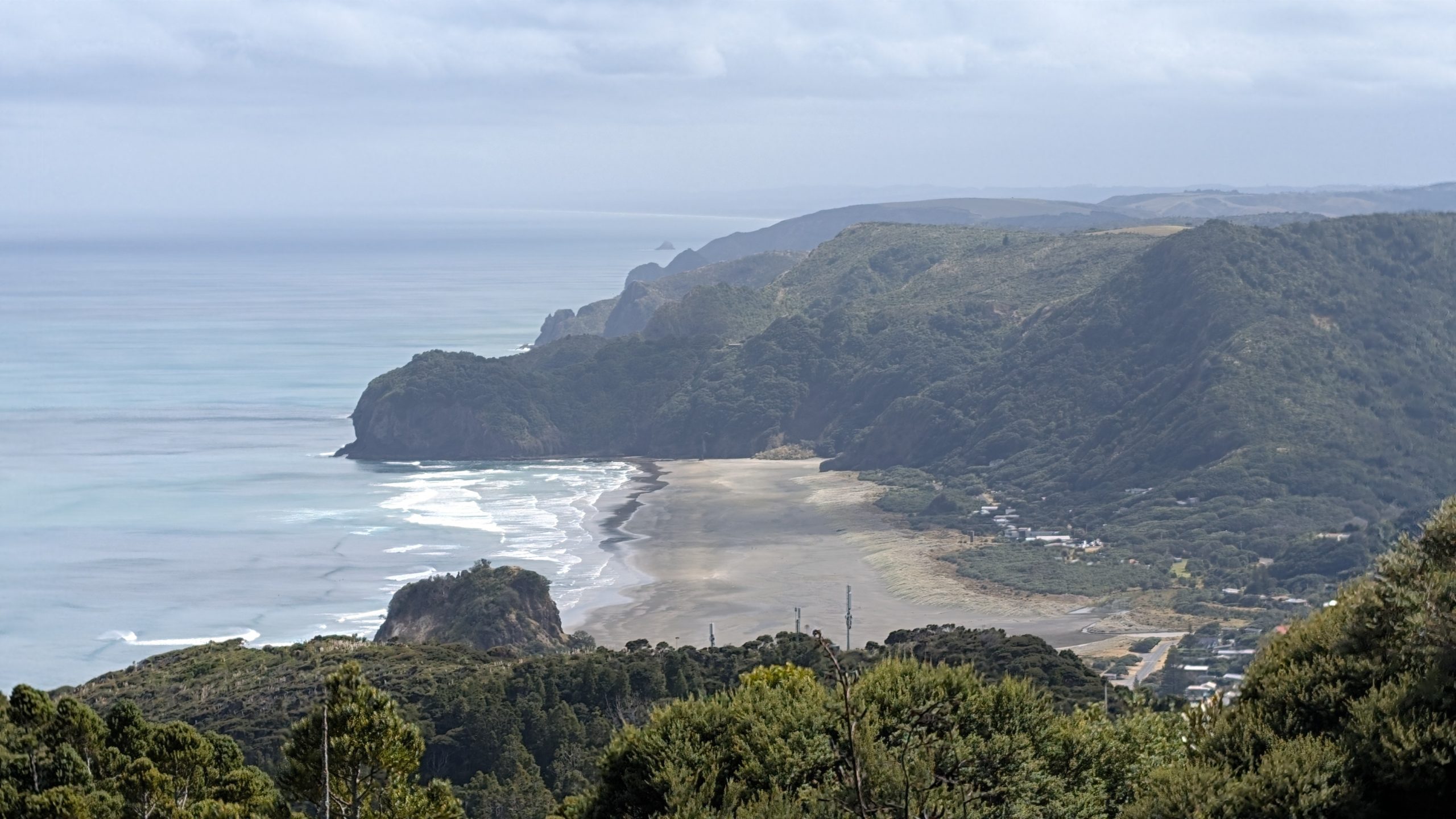
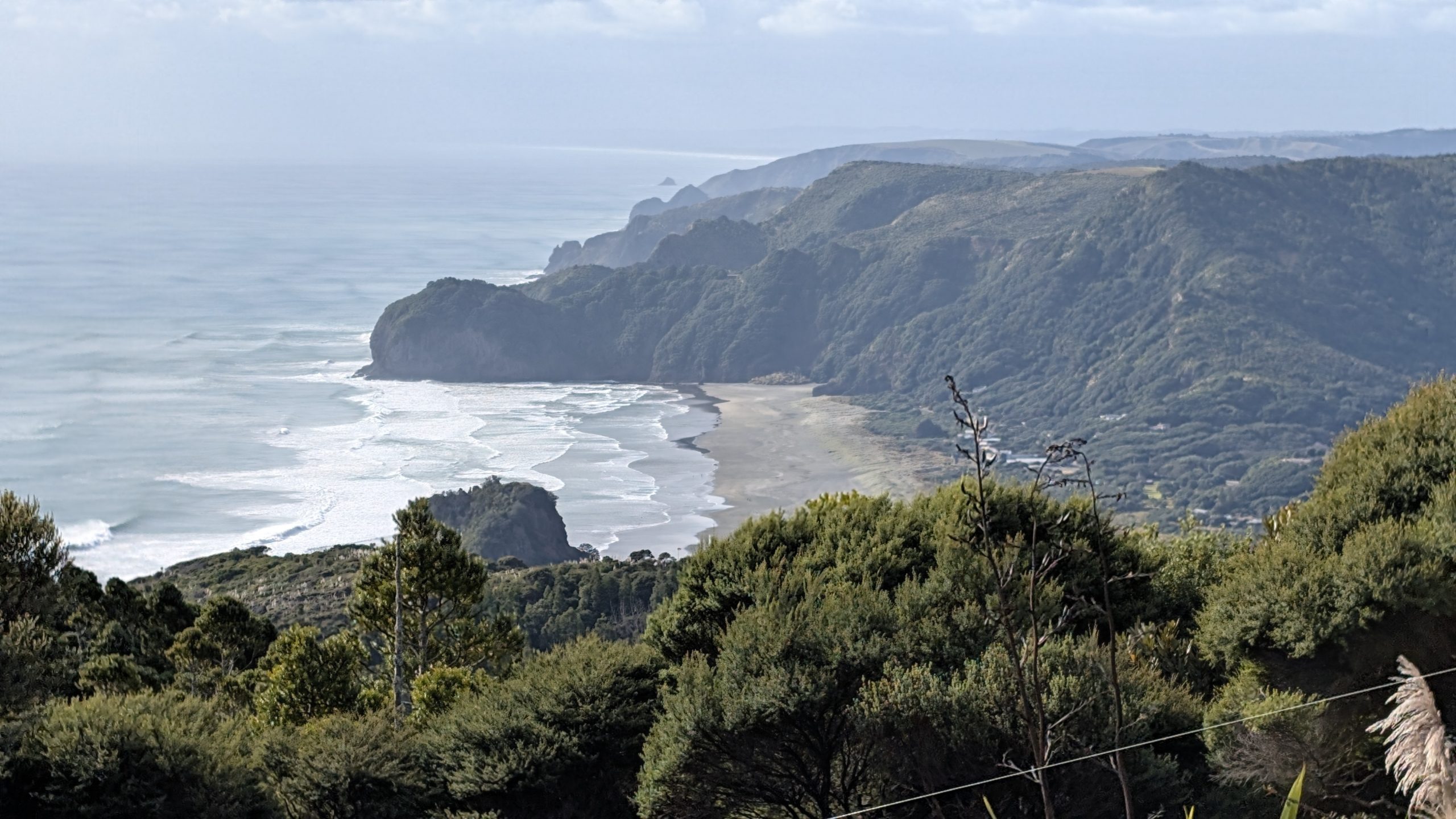
We then had a very relaxing time exploring Fletcher Bay and really took our time traveling back to Colville. The views of the beach and the surrounding hills at Fletcher Bay were lovely.
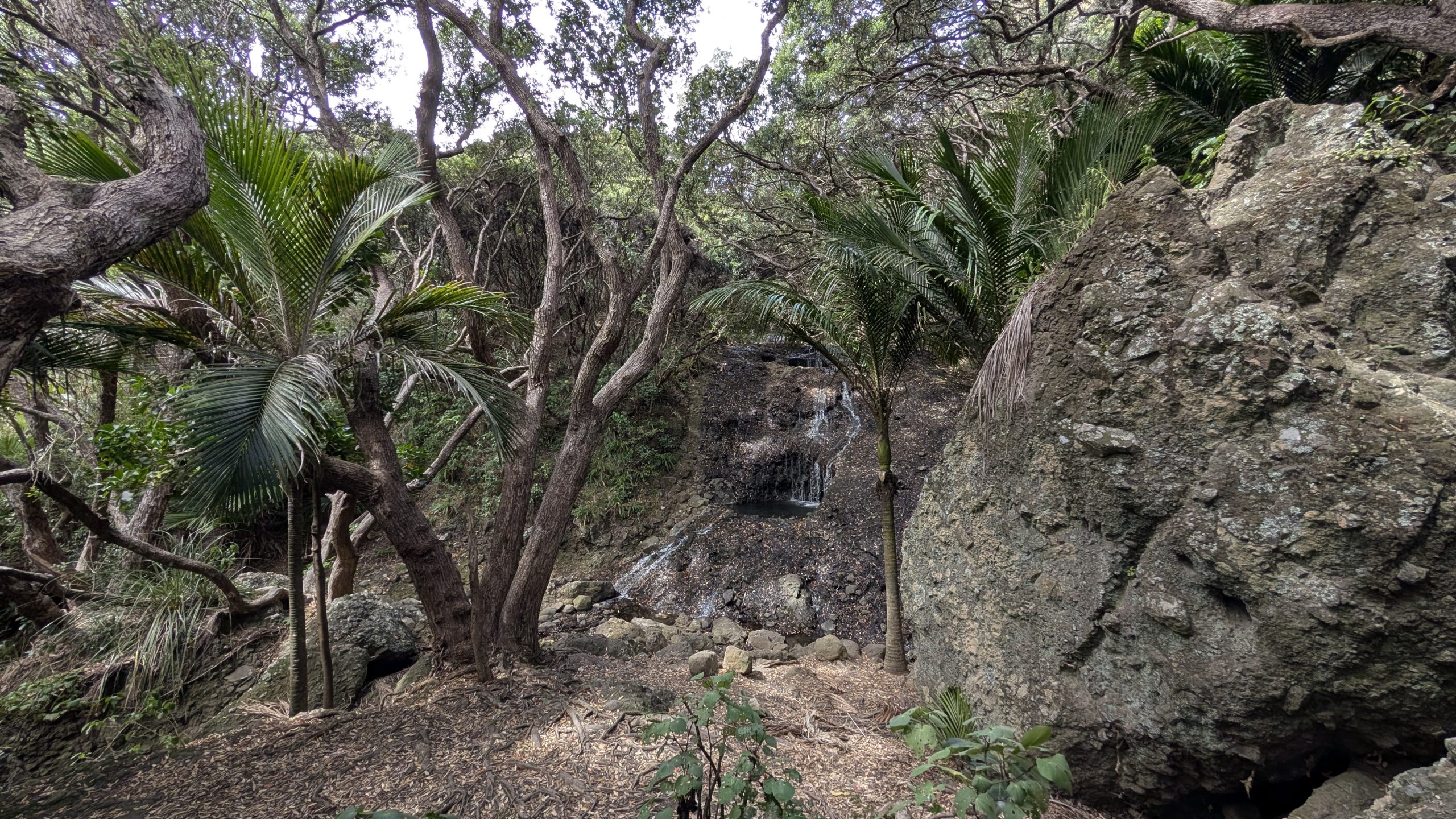
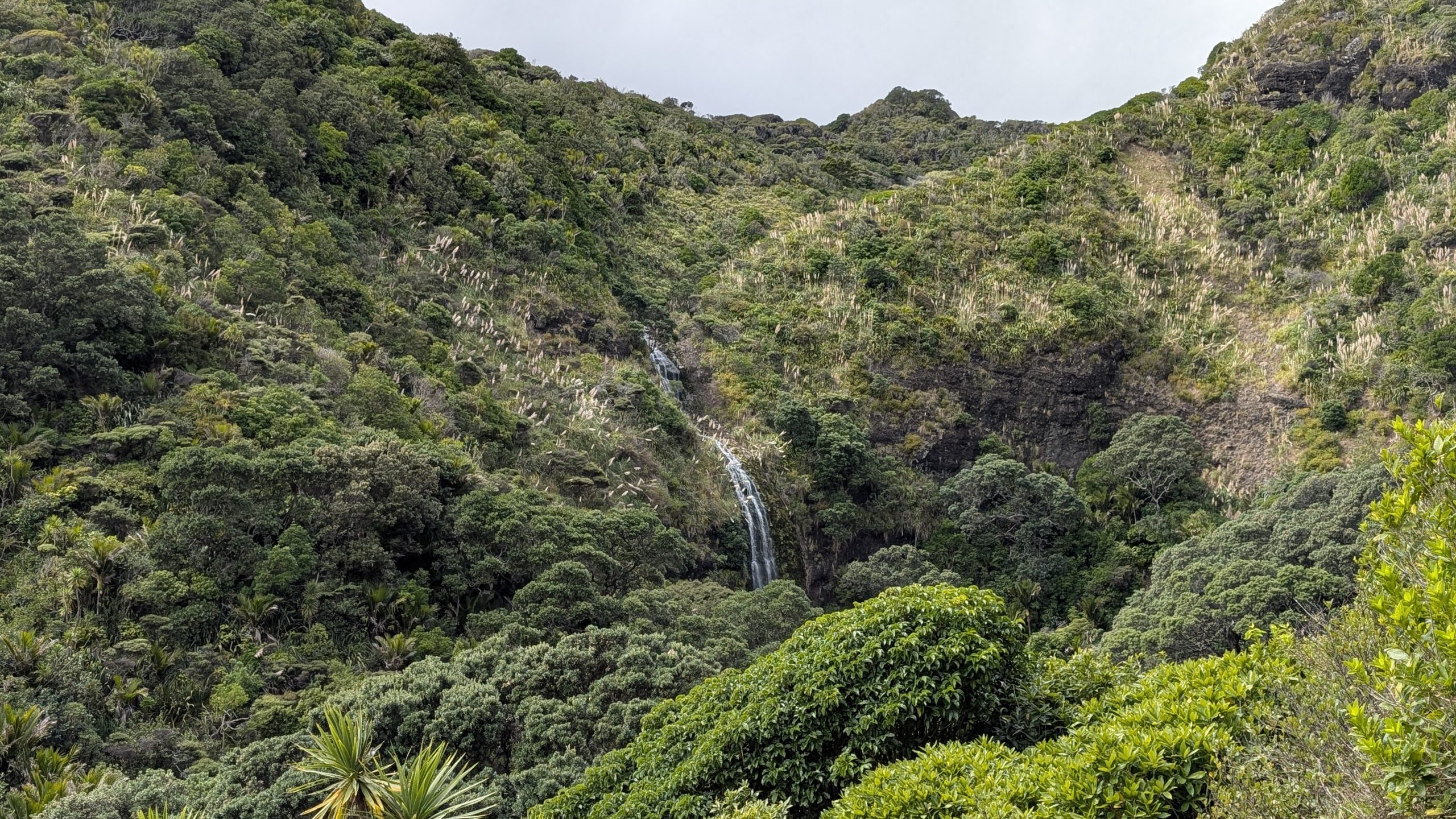
View from the Fletcher Bay carparkView near the start of the Coromandel WalkwayThe beach at Fletcher Bay
On the drive back to Port Jackson we stopped at a lookout that was at the northernmost point of the Coromandel Peninsula.
View to the westView to the east
Our next stop was the upper carpark trailhead for the Muriwai Hilltop Walk. This was an easy walk that had wonderful coastal views. It was one of my favorite short walks on the entire trip. It followed a ridge with views the entire way, and it was so peaceful. We encountered only one other person along the trail.
Muriwai Hilltop WalkCoastal view from the Muriwai Hilltop WalkPort Jackson Beach, view from the Muriwai Hilltop Walk
After the hike we drove back down to Port Jackson and stopped at the beach. The only public facilities at Port Jackson appeared to be a campground at the beach. The remaining part of Port Jackson was a few houses along private roads.
Port Jackson Beach, looking westPort Jackson Beach, looking east
Past Port Jackson the road climbed up to a nice view of the beach below.
Port Jackson Beach
Then the road dropped back down to sea level, following the coast for most of the way back to Colville. We stopped briefly at Fantail Bay, where there was another campground.
Fantail Bay, looking southFantail Bay
We drove back to the road construction area and this time had less than a 10-minute wait. We finally rejoined the paved section of the road and stopped at the Otautu Bay wharf.
Otautu Bay
Our final stop for the day was at Colville Bay, just down the road from our motel room.
Colville BayThe beach at Colville BayRoad to the motel from Colville Bay
Back at the motel, I walked around the pretty grounds.
Front lawn of the Colville Bay MotelPretty treesAnd pretty flowers
We fixed dinner and relaxed for the rest of the evening.
Today was devoted to exploring some areas of Coromandel that we had not seen on past trips. Many of the spots were beaches. Unfortunately it was not looking good to be a beach day: the weather forecast was for mostly cloudy with light periods of rain.
Just for fun we stopped to see the Hot Water Beach. This is a big tourist bucket list item. It involves going to the beach within 2 hours of low tide, and then finding a spot near the edge of the water to dig a hole in the sand deep enough to reach hot water below, and finally sitting your butt down into the hot water for a nice geothermal soak. Shovels could be conveniently rented at a shop nearby. Neither of us had any desire to actually participate in this, but it was entertaining to watch the others search for a hot water spot. Since we were there over an hour past the low tide time, many people were not digging down deep enough at the higher ground level. I found lots of cool water holes that had been abandoned.
Parking nearest to the main attraction was not free, but about two tenths of a mile down the beach there was free parking at the Domain Road Carpark. We parked there and just walked to where all of the people were congregating.
Hot Water BeachBeach area near the Domain Road Carpark
You can read more about Heinrich's experience here.
We drove north to the town of Whitianga where we stopped at the New World supermarket for some groceries for the next few days and then topped off the car with gas. Then we drove further north to a roadside stop on Black Jack Hill, where there was a lookout with views of the Pacific Ocean and some of the beaches below. Unfortunately with the total cloud cover that refused to dissipate, the views were less than stellar.
Ocean view from Black Jack Hill
We drove back down the hill and visited a couple of beaches: Kuaotunu Beach and Matarangi Beach. At the west end of Kuaotunu Beach was a nice small sea arch.
Kuaotunu BeachSea arch at the west end of Kuaotunu BeachClose up view of the sea archMatarangi Beach, looking westMatarangi Beach, looking east
We drove to the boat dock at the southern end of the little peninsula that fronted Matarangi Beach. We had some nice views of the Whangapoua Harbour.
Whangapoua HarbourBoat dock at Whangapoua Harbour
Next we drove west to the town of Coromandel and took a short hike on the Kauri Block Track. The walk passed a young grove of kauri trees that were planted in 2014 and dedicated to the people of Christchurch following the 2010 and 2011 earthquakes. It climbed to a nice panoramic view of the Coromandel Peninsula.
Wyuna Bay view from the Kauri Block Track lookoutTown of Coromandel view from the Kauri Block Track lookoutCoromandel Peninsula view from the Kauri Block Track lookout
Next we drove north and stopped at the Driving Creek Railway to look around. This is New Zealand's only narrow-gauge mountain railway. People can book a 1 hour 15 mnute tour that climbs through a regenerating native forest. We did not have enough time to take the tour but might consider it on a future trip. We did go on some of the free activities that included some short trails that stopped at a mine entrance and a predator-proof wildlife sanctuary. We walked through the sanctuary but did not see any interesting birds.
Drving Creek Railway train
Mine entrance
Next we drove further north to our accommodation for the next two nights at the Colville Bay Motel. We had a one bedroom unit with a kitchenette. It was the farthest north accommodation I was able to find on the western side of the Coromandel Peninsula. I found it several months earlier using a Google Maps search and booked directly with the owner. It was a nice place at a very reasonable price. I would stay there again.
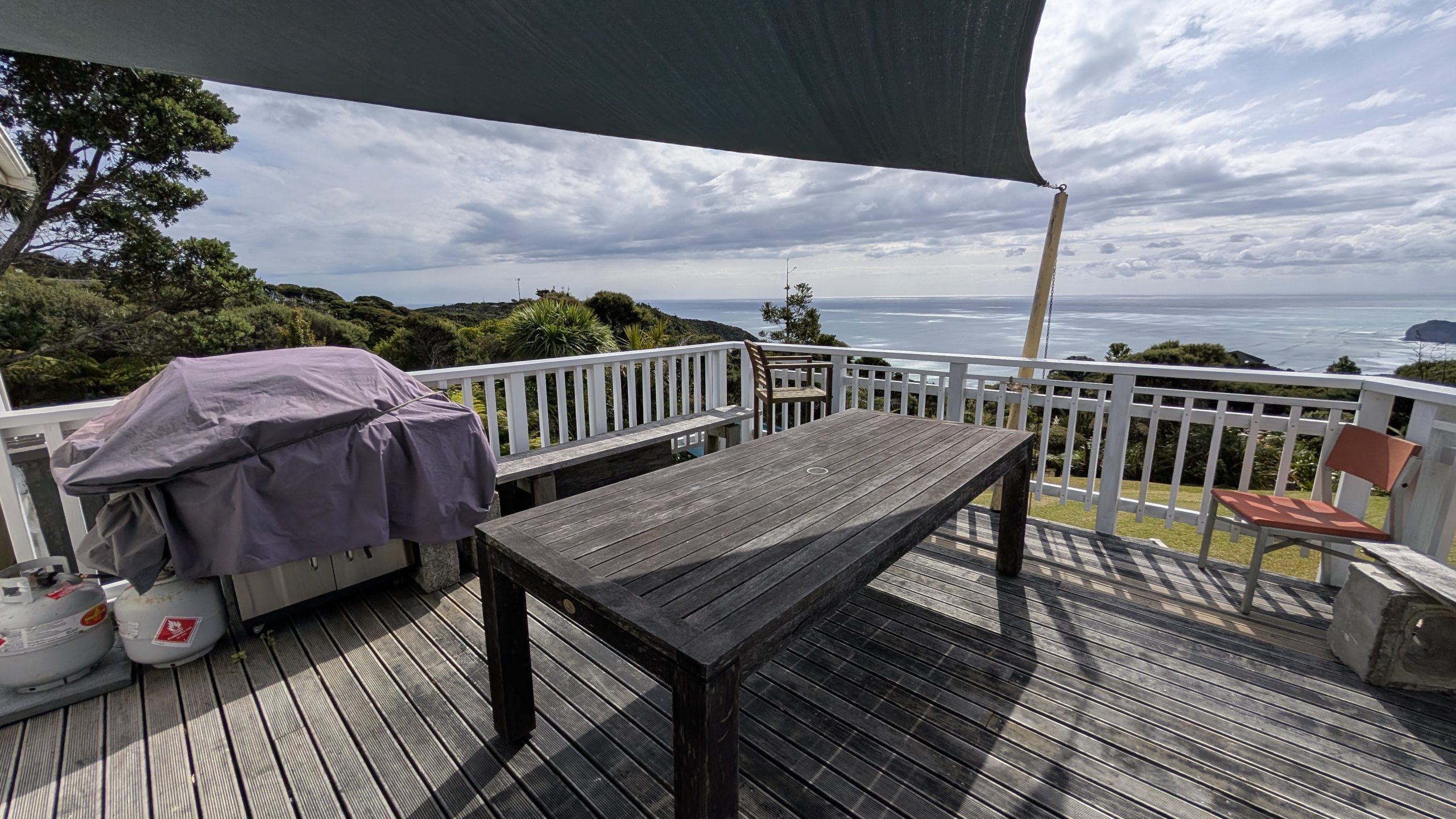
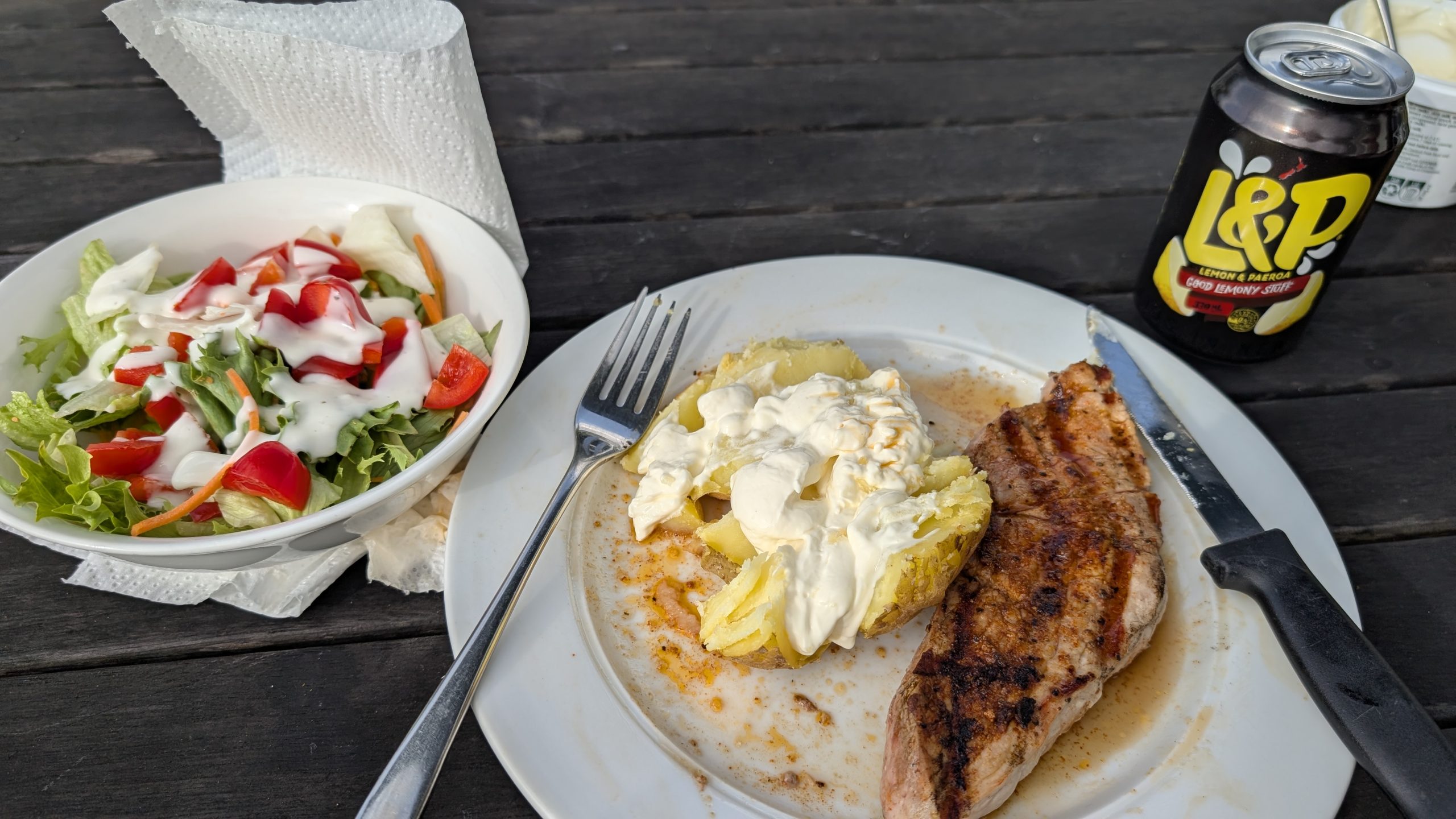
We used the outdoor grill for our dinner.
Dinner: leg of lamb steak, baked potato, and salad
In the morning we decided to take a one-way water taxi to Cathedral Cove and then walk back to Hahei via the trail and road. The water taxi departed from Hahei Beach, so it was just a short walk from our room. We were told to look for the flags on the beach for the water taxi. But when we went out to the beach, the only flags we saw were for the kayaks. We were early, so we waited. And waited... finally I saw at the other end of the beach some people setting up flags, and a boat was being launched. So we scrambled over there (half running, it was about 2 tenths of a mile) only to discover that this was again the wrong company. And then suddenly at the other end of the beach, where we just were a few minutes before, I saw another boat arrive. This was about 10 minutes after the supposed departure time of 9 AM. So we scrambled back and managed to get there in time. There were only 2 other people waiting there to get on the boat.
The water taxi was a short 8-minute ride to Cathedral Cove. It was nice timing since it was about an hour after low tide and we were on the first boat, so all of the crowds of people had not yet arrived.
Water taxi ride to Cathedral Cove
Approaching Cathedral CoveCathedral Cove view from the water taxiWater taxi departing from the cove
There were sea caves on the south side of the cove. One was still barely reachable before the tide came in, so I walked over to explore the inside.
The first sea cave, viewed from the water taxiThe second sea cave, accessible near low tideView from inside the sea cave
I noticed a small waterfall on the south side of the cove. It was flowing a steady stream. Neither of us remember seeing it when we last visited in 2019. I think it probably was not flowing then since 2019 was a very dry year, unlike 2026 which has had plenty of rain.
Cathedral Cove waterfall
Next we walked over to the main attraction: the Cathedral Cove arch. It was nice and uncrowded. We walked through the arch to the beach on the other side and observed Te Hoho Rock.
Cathedral Cove archInside the archTe Hoho Rock
We spent about an hour at the cove and departed at about the time when a steady stream of people started to arrive. The trail from the cove was an uphill climb through a pretty forest. We took the side trail to the Cathedral Cove lookout which had great views of the cove and nearby McHands Bay.
Trail from Cathedral CoveCathedral Cove view from the lookoutTe Hoho view from the lookoutMcHands Bay
We walked back to the main trail and continued on to the trail head and bus parking area. From there we walked down the road back to the town of Hahei. In 2019 we had been able to follow a trail that went from the bus parking area to Hahei Beach, but it has been closed for a while due to washouts. It was a total of about 1.5 hours of walking from the cove back to Hahei, quite a bit longer than the 8-minute water taxi ride.
View from the bus parking areaHahei Beach view from the road
Back in town, we stopped at the Hahei Eatery and Ice Cream to have lunch, and ice cream afterwards. Then it was just a short walk back to our room.
Cheeseburger lunch
Map: Day 34
For our afternoon adventure we took a 15-minute drive to Cooks Beach and the Shakespeare Cliff Lookout. This was an area we had walked to in 2019 when we stayed in the nearby town of Whitianga and took the passenger ferry. Having the car gave us more time to explore the area.
Cooks BeachLonely Bay and Cooks Beach view from the Shakespeare Cliff Lookout
We drove down to the ferry landing area, and I took a walk up to Whitianga Rock which had nice views of the town of Whitianga and the ferry area.
View of Back Bay from Whitianga RockView of the town of Whitianga and the wharf from Whitianga Rock
We drove back to our room and used the grill to fix dinner.
Dinner: pork chops, rice, applesauce, and cole slaw
We got up at 5:30 AM to get ready for our morning flight to Auckland. We had one small hiccup in finding the place to return the rental car, since it was an after hours return and I did not see in the instructions that this would be in a different place. But we still had plenty of time before our flight.
Going through security took more time than what we were used to. I missed being able to use our TSA precheck. I had to take off my hiking boots, and both of our backpacks ended up getting manually inspected. I think that was due to all of the electronics we had jammed inside. Otherwise the rest of the check in was uneventful, and our flight left on time.
Sitting on the right side of the plane, we had good views of the Akaroa area, central mountains, and the Queen Charlotte Sound.
Mountains north of Christchurch, most likely the northern Southern Alps or the Kaikoura Range
Queen Charlotte Sound
On the North Island we could see Mount Tongariro and Lake Taupo in the distance. The sun was at a bad angle overhead, making my plane pictures look washed out.
Lake Taupo on the left and Mount Tongariro with some snow on the right
Landing in Auckland with a brief distant view of the city
The plane arrived on time, and we collected our luggage and got our new rental car, which was another Hyundai Ioniq hybrid from the same company, Apex Car Rentals. The only difference was the color: silver instead of white.
Map: Day 33
Then we were on our way and out of the city to the Coromandel district where we would be spending the next four days. Our first stop was the PAC 'n SAVE supermarket in Thames, where we restocked our groceries for the next few days. The trip took a bit longer than expected due to a large detour we had to make. Highway 2 was closed for several hours due to a very bad fatal accident, a head-on between a truck and a car.
Our next stop was the Broken Hills area in the Coromandel district. This area had several trails in the forest through minng tunnels, passing by waterfalls, mine entrances, and other fun features.
We hiked the Water Race Track that followed a mine water race and passed through three tunnels.
The first tunnel on the Water Race TrackTunnels 2 and 3 on the Water Race Track were close together
The Government Battery waterfall was near the entrance to the track.
Government Battery WaterfallGovernment Battery area
Next I took a short hike on the Gem of the Boom track, which had some fun features: a small waterfall, the entrance to a mine, and a "jail."
Small waterfall
Mine entrance in Broken HillsEntrance to the Jail, with something inside...An inmate that never made it out!
We drove on to the Hahei Beach Resort. This was a very nice holiday park where we had reserved a garden view studio for two nights.
View outside our room at the Hahei Beach Resort
Just around the corner from our room was a lovely view of Hahei Beach and the little islands in the area.
Hahei Beach, looking northHahei Beach, looking south
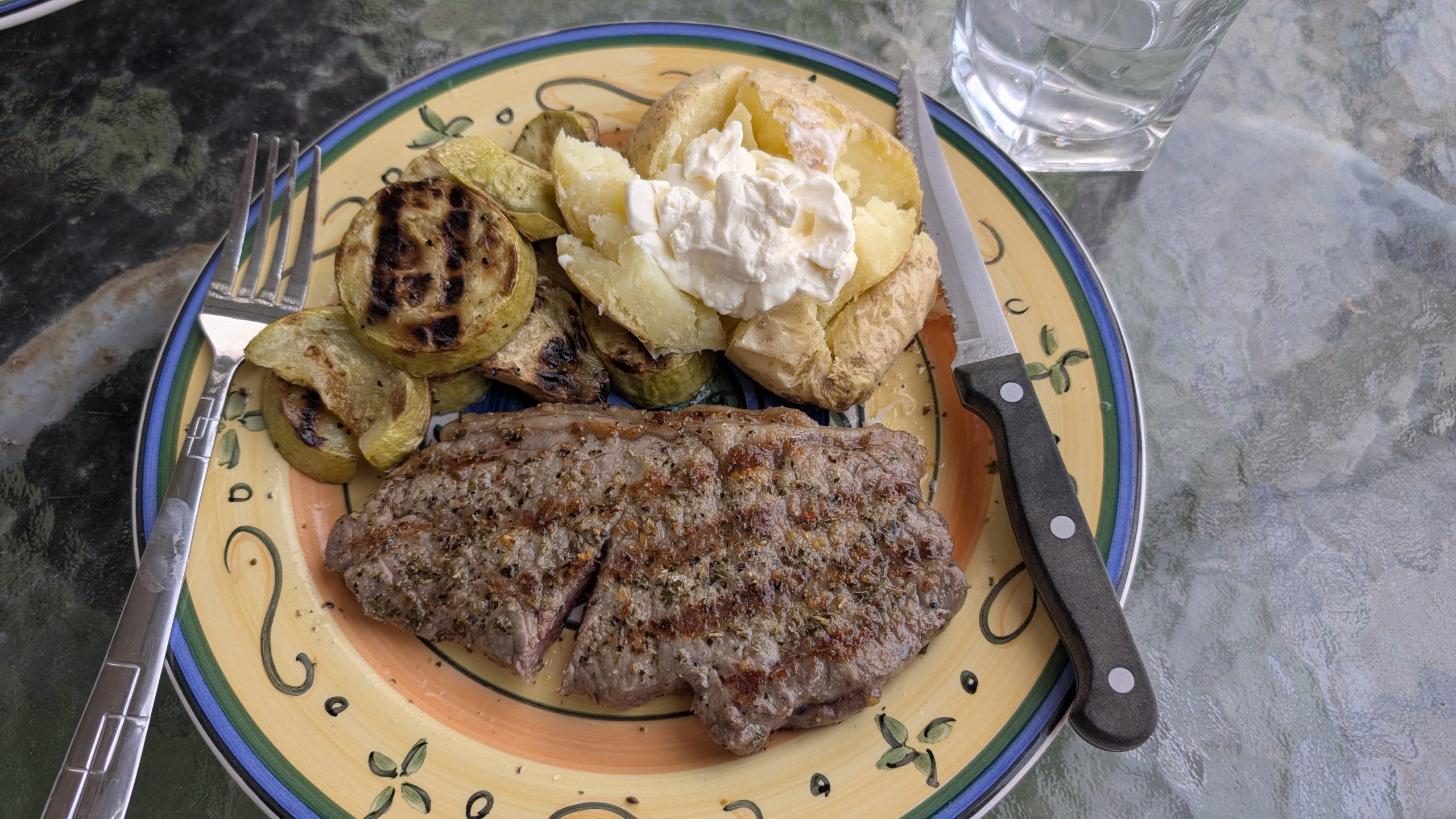
There was a propane grill a few feet away from the front of our room, and we used it to cook some ribeye steaks for dinner.
Dinner: ribeye steak with baked potato and cole slaw
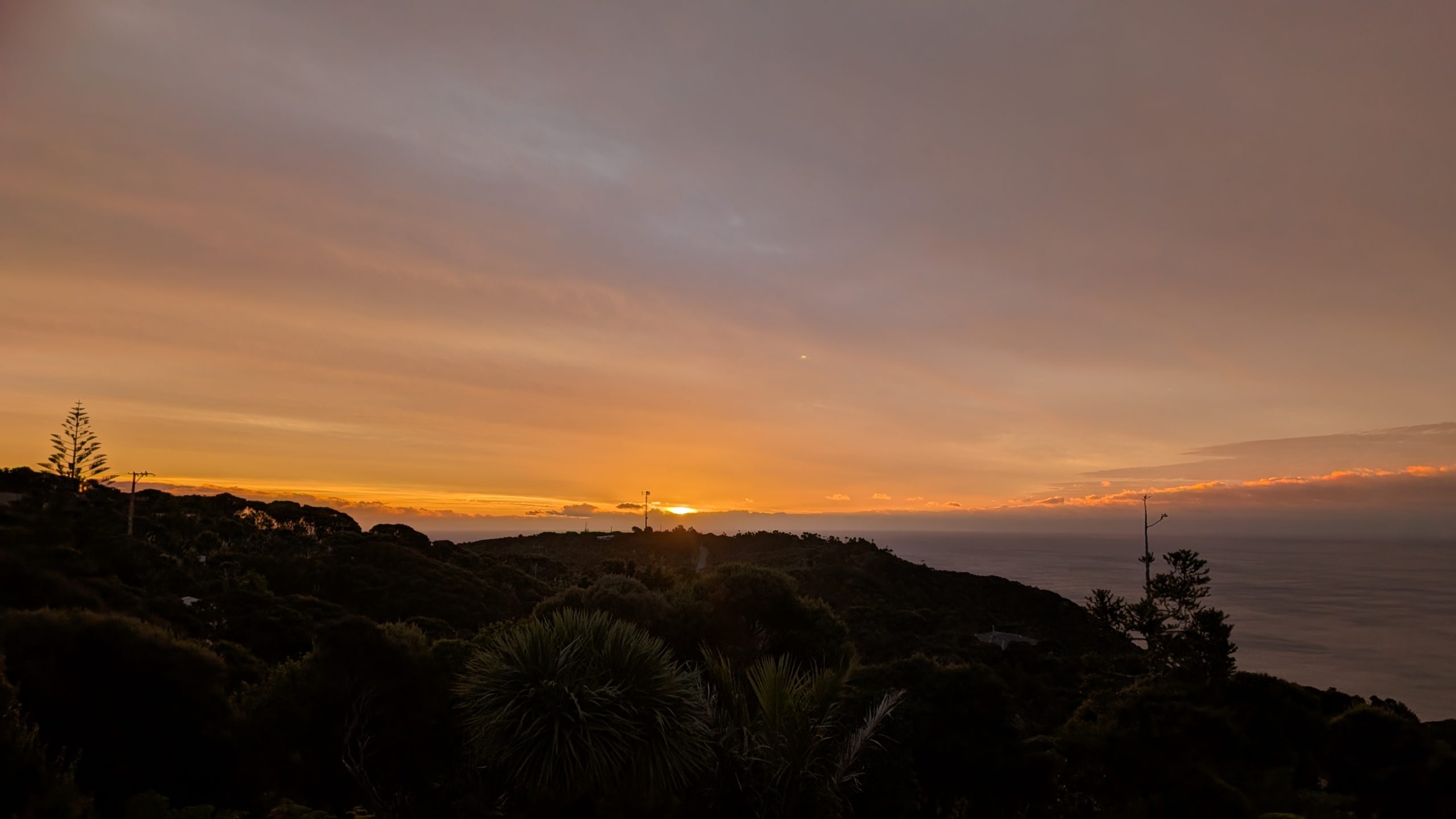
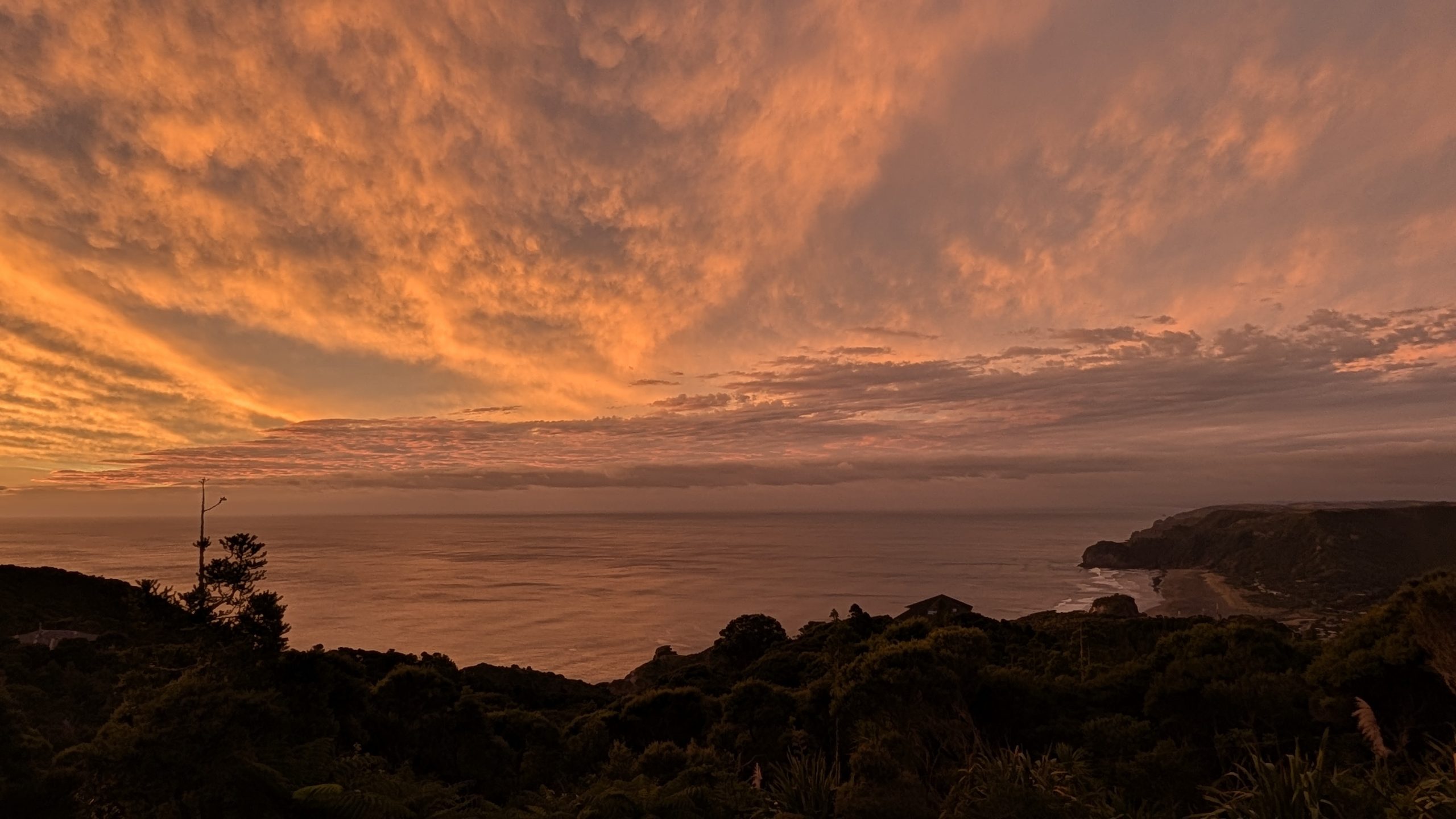
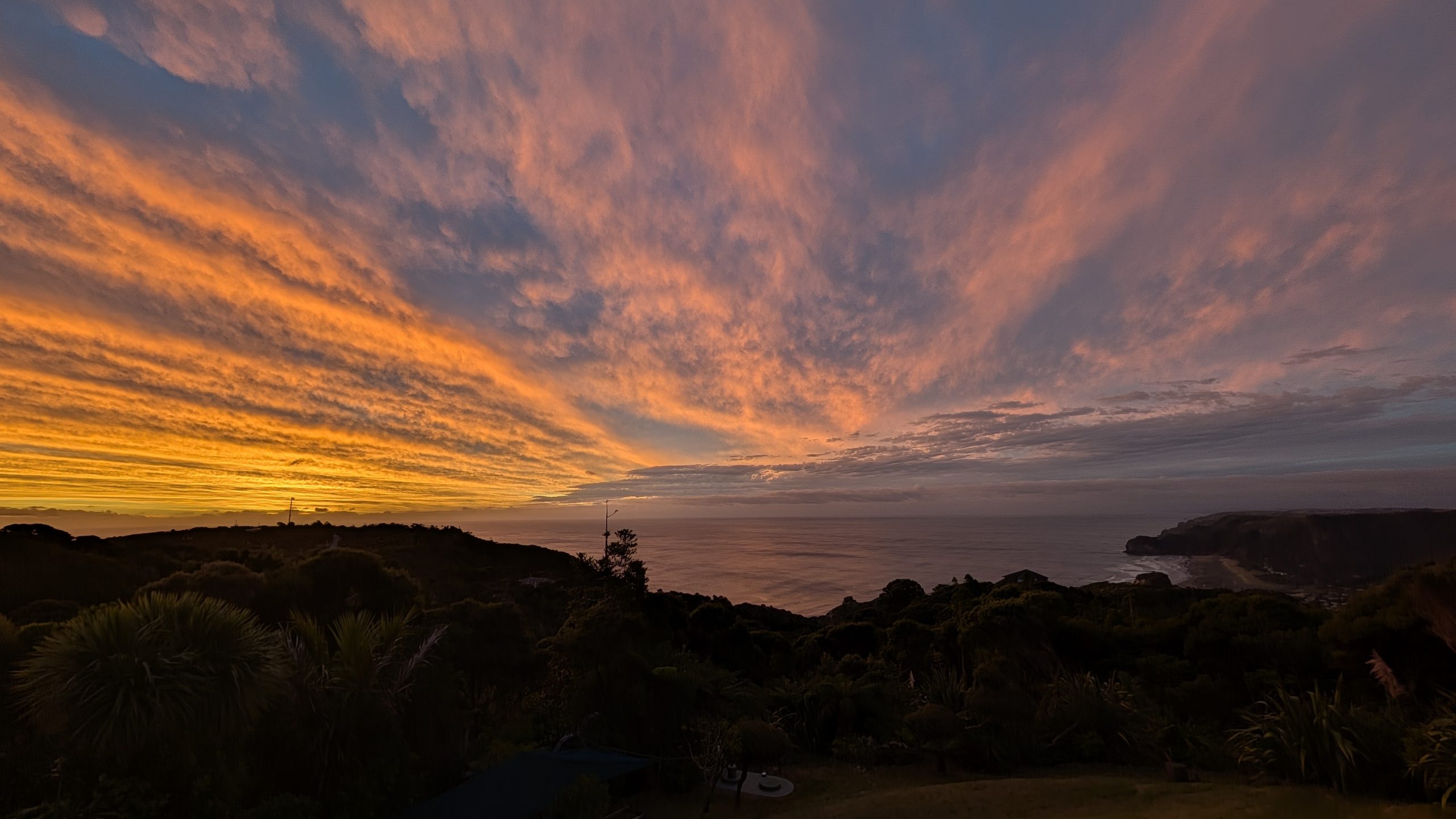
After dinner I walked back out to the view of the beach and saw some nice sunset colors.
Today was mainly a driving day to get back to Christchurch near the airport, where we had to get ready to leave for our flight to Auckland the next morning. Our time on the South Island was coming to an end.
We woke up to clear blue skies in the morning: nice weather although it was still a bit windy and chilly. We checked out of the room and drove across the street to the Moeraki Centenary Park where there was a small beach and some nice views.
Path to the beachBeach at Moeraki Centenary Park
We drove to Oamaru and spent a couple of hours walking around the wharf area. We walked to the Oamaru Penguins observation area. This is another paid attraction to see the little blue penguins scamper up the beach after sunset. However, it is more of a grandstand experience than what we had in Dunedin, and no photography was allowed. During the day there were no penguins, but we did see fur seals sleeping on the rocks.
Oamau fur seal
We walked down Holmes Wharf and had some nice views of the area.
View of the bluff and Oamaru Penguins area from Holmes WharfHolmes Wharf area
We stopped at the New World supermarket in Oamaru to buy a few treats and items for dinner. Then we continued the long drive to Christchurch. We checked into our room at the North South Holiday Park that was just a few miles north of the Christchurch airport. We had the "Tourist Flat" cabin with a kitchenette.
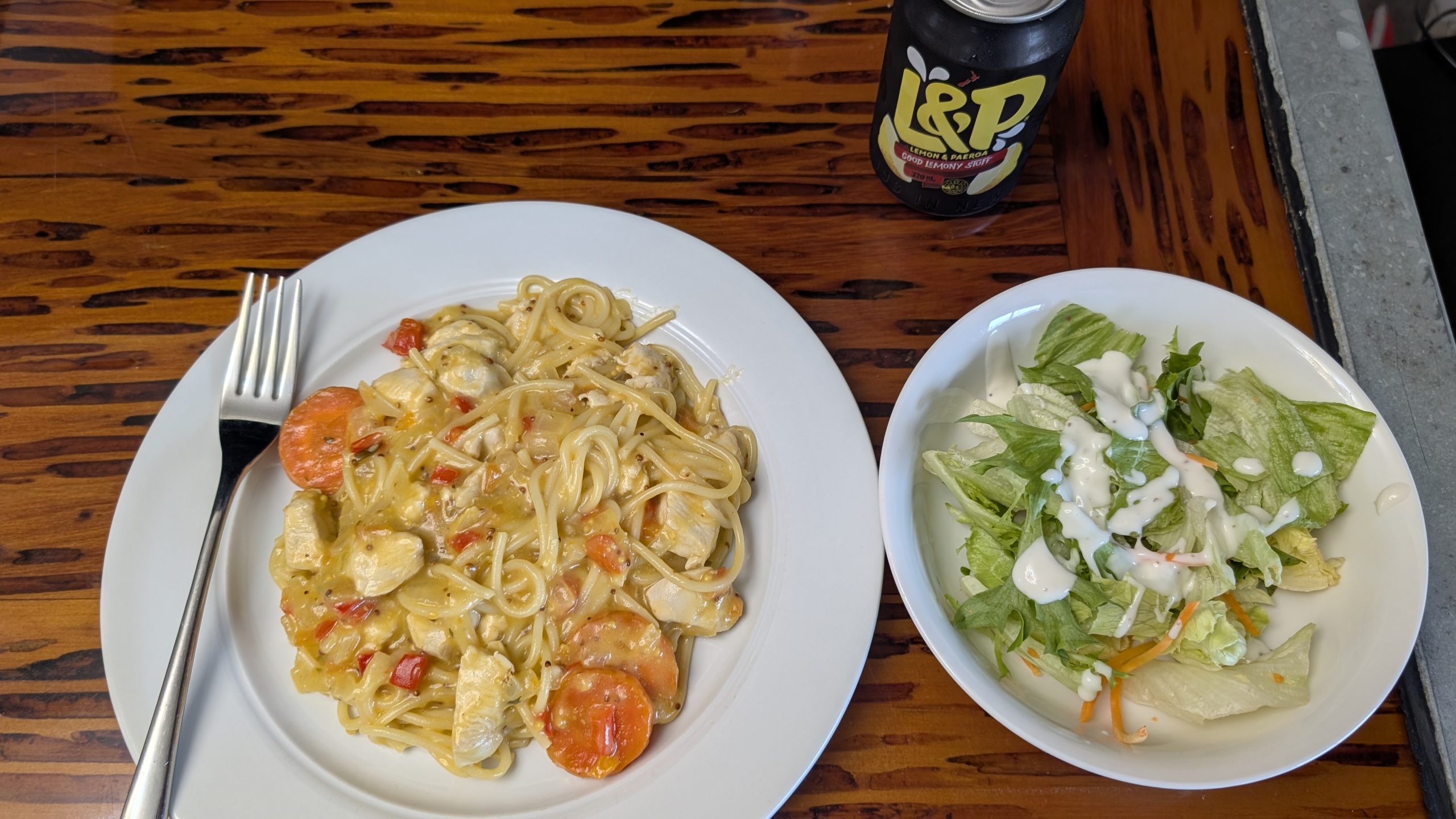
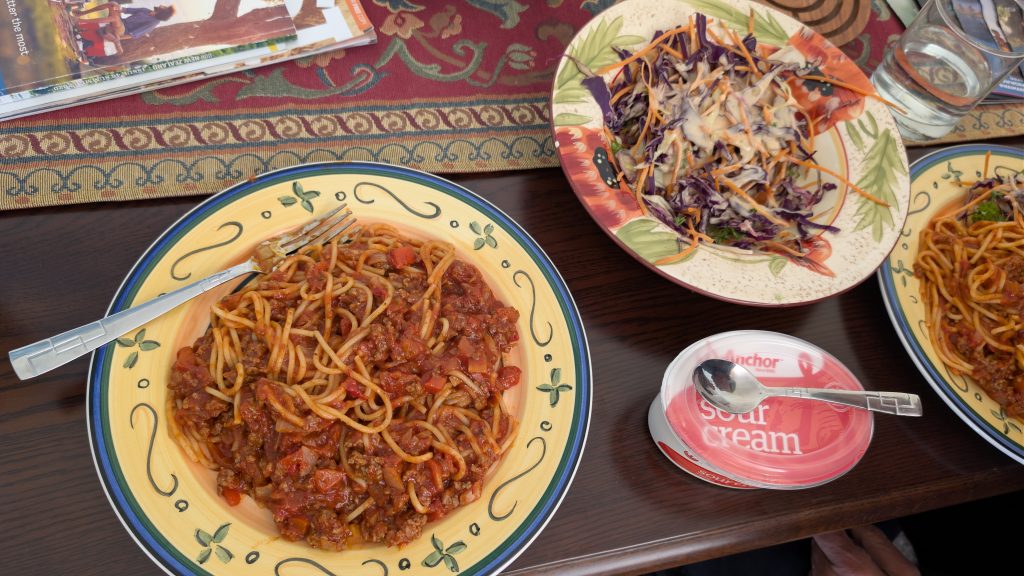
We made spaghetti and a salad for dinner. One drawback of flying to the North Island vs. using the ferry was we had to either use up or throw away our perishables, and then we would have to restock again once we got off the plane. So we used as much as we could for our dinner that night and for breakfast the following morning. We ended up only having to give away a few condiments: we donated them to the shared kitchen used by the campers.
Final dinner on the South Island: spaghetti and a salad
After dinner Heinrich drove to the gas station down the street to do the final fill up on the rental car. We cleaned out the car and repacked our suitcases for our plane flight, and then we went to bed early to get a good night's sleep.
We woke up to a partly cloudy but extremely windy day. It was time to check out of the beach house and move north to our next destination at Moeraki. On the way we made a side trip to Mount Cargill. We drove up the road to the summit where we had panoramic views of the entire city of Dunedin. Unfortunately it was so windy that we did not want to spent much time up there or take any of the trails that were in the area. The short walk to the summit from the car park was extremely uncomfortable with the wind. It felt like I was in Iceland!
Dunedin city view from near the summit of Mount CargillMount Cargill summit
We drove back down the mountain and continued further north after stopping for a gas fill-up. We stopped at the Puketaraki Lookout which had some nice but windy views. A sign at the lookout mentioned there were some blowholes close by on Huriawa Pa, and they might by really good today with all of the wind. It might be worth checking out on a future visit.
Otago Peninsula viewTown of Karitane, Huriawa Pa, and Waikouaiti Beach
We continued the drive on to Shag Point. I was hoping to get out of the wind, but it just would not let up. The picnic area shortly before Shag Point was a little more sheltered, and we watched some fur seals. One seal was resting only a few feet from where we parked the car. Then we drove out to the point and watched more fur seals in the gusty wind.
Fur seal resting near our parked car at the picnic areaFur seal at Shag PointMore fur seals at Shag Point
We drove to an area just north of Shag Point that had a lookout onto a beach containing hundreds of mini Moeraki boulders. It was not low tide, so not a good time to walk down to the beach and the faint trail at that location was overgrown and looked hazardous. So we viewed the mini boulders from the top of the cliff.
Mini Moeraki boulders beachZoomed in view of some of the mini bouldersMore mini bouldersMini boulders area looking northAnother cluster of mini boulders
We drove on to Moeraki and checked into our lodging at the Moeraki Village Holiday Park. We had a studio apartment with a kitchen and a nice ocean view.
The tide was too high to visit the Moeraki boulders, but it was the perfect time to drive to nearby Katiki Point, where we saw a group of yellow-eyed penguins in 2023. We waited for about two hours at the same spot where we had previously seen them, but we were not successful this time. However we did get to watch many fur seals.
Fur seal exiting the ocean
Fur seal climbing on the rocks
A group of fur seals
We drove back to our room and cooked dinner: eggs and potatoes. We had a nice view of sunset colors from our room.
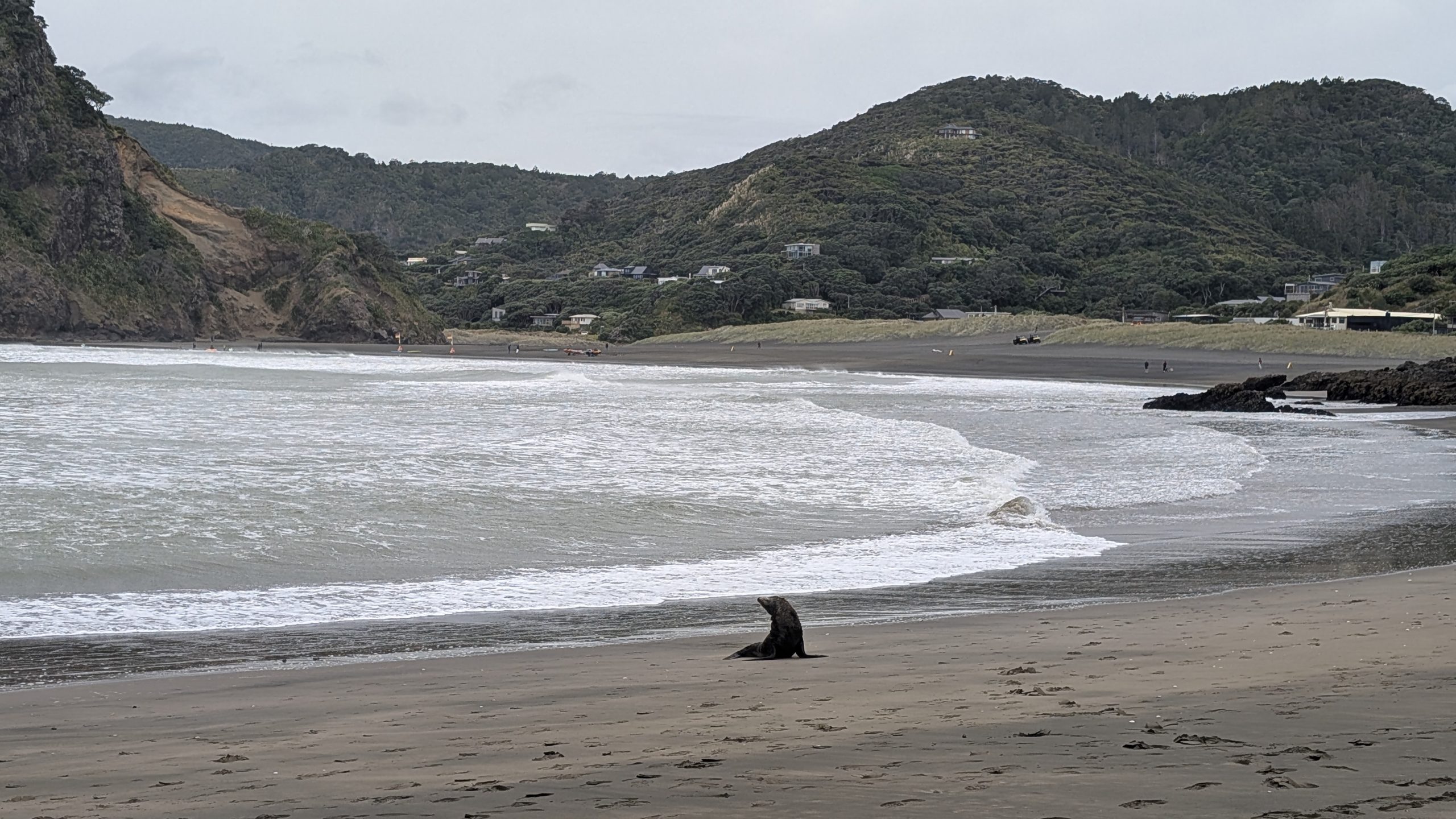
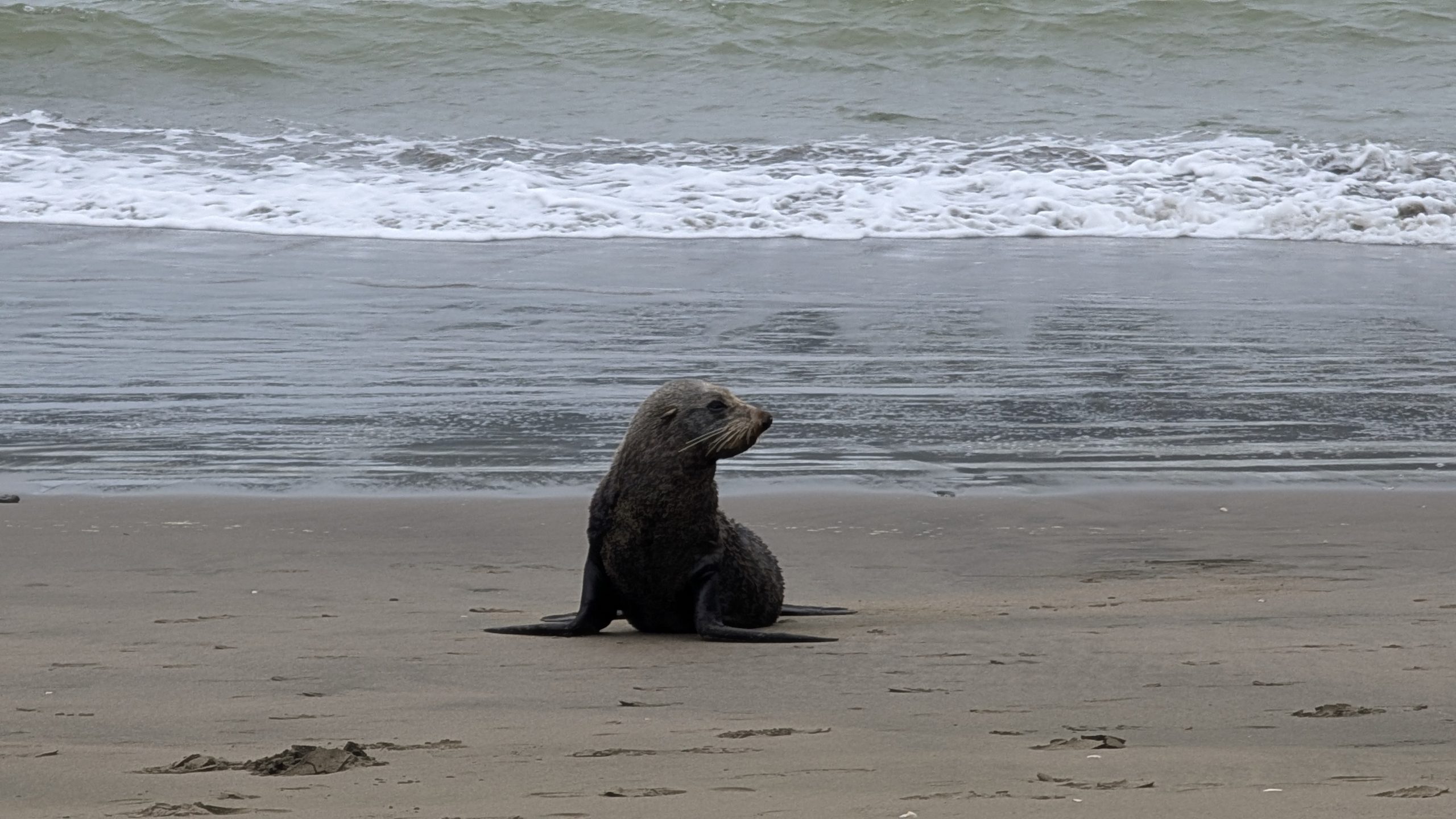
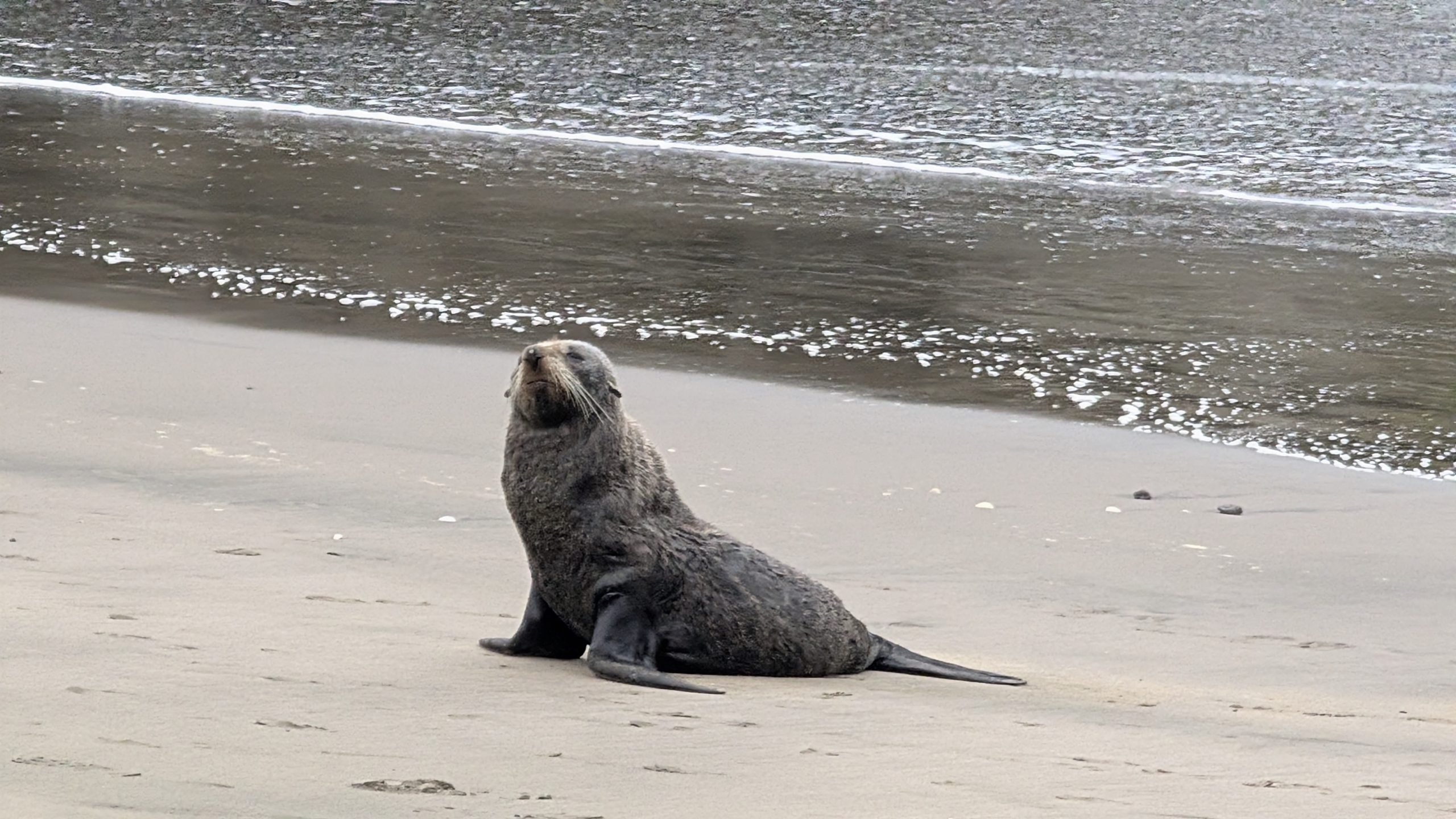
We wake up to a partly cloudy day, a bit chilly but not too windy. I walked down to the beach and was entertained by a sea lion at the far end. I watched him walk out to the water and swim away.
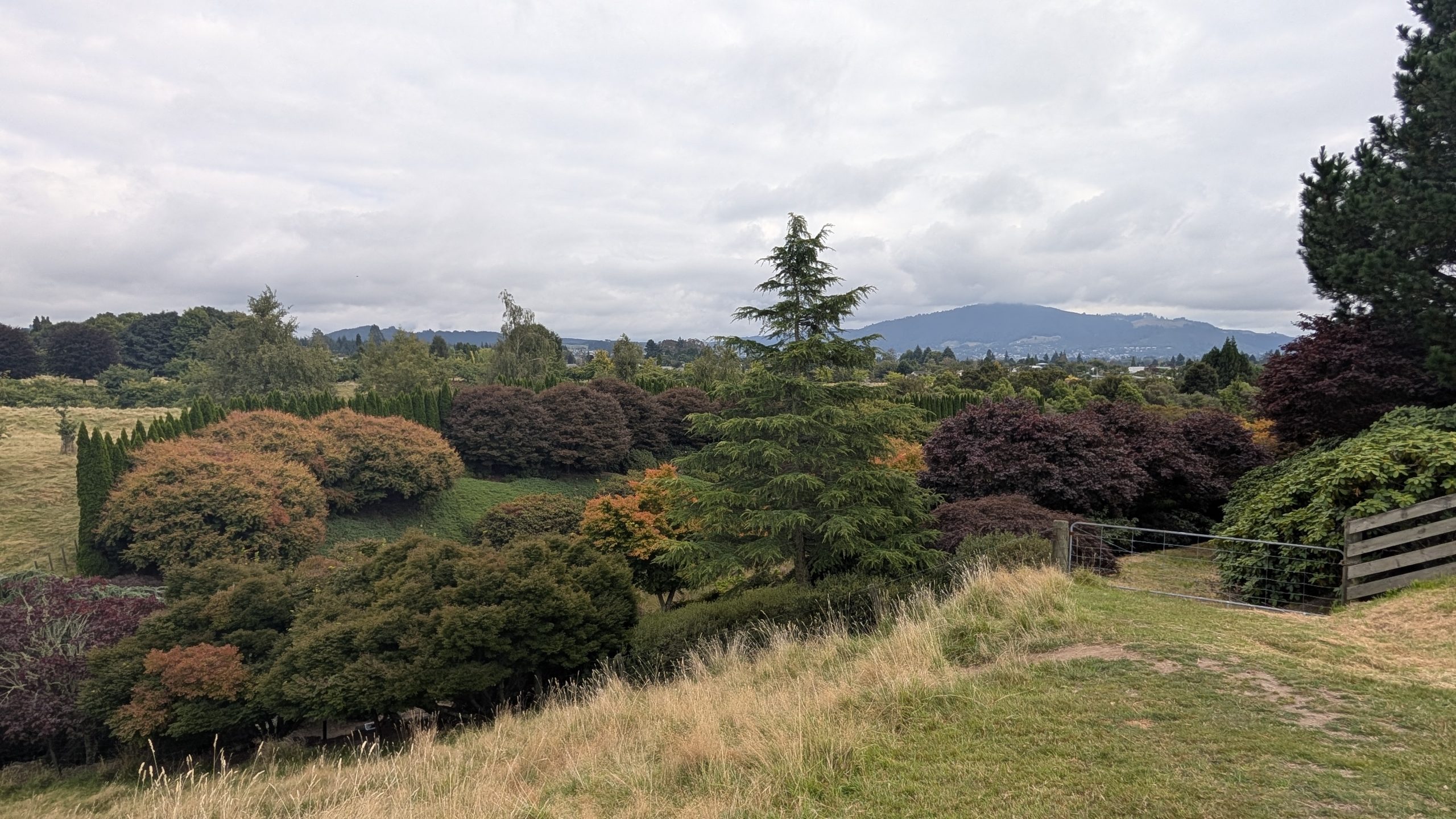
Sea lion on Ta Rauone Beach, part 1
Sea lion on Ta Rauone Beach, part 2
Sea lion on Ta Rauone Beach, part 3
We had free time in the morning before our afternoon tour. We drove out to the end of the road on the Otago Peninsula to where we had watched the little penguins the week before. There were no signs of them today in broad daylight, but the views were pretty.
Waiwhakaheke Overlook with the lighthouse in the distanceThe walk down to the Blue Penguins Pukekura viewing platformPenguin Beach
We walked down the road to a distant view of the penguin viewing platform. The previous week we saw people gathering at this point to try to see the penguins from afar. The viewing platform blocks seeing the small beach cove from here, altlhough I suppose it might be possible to see a few penguins coming into the beach area from farther away. More interesting to me was the view across the channel to the area we had visited in 2023: Aramoana, Heyward Point, and Spit Beach.
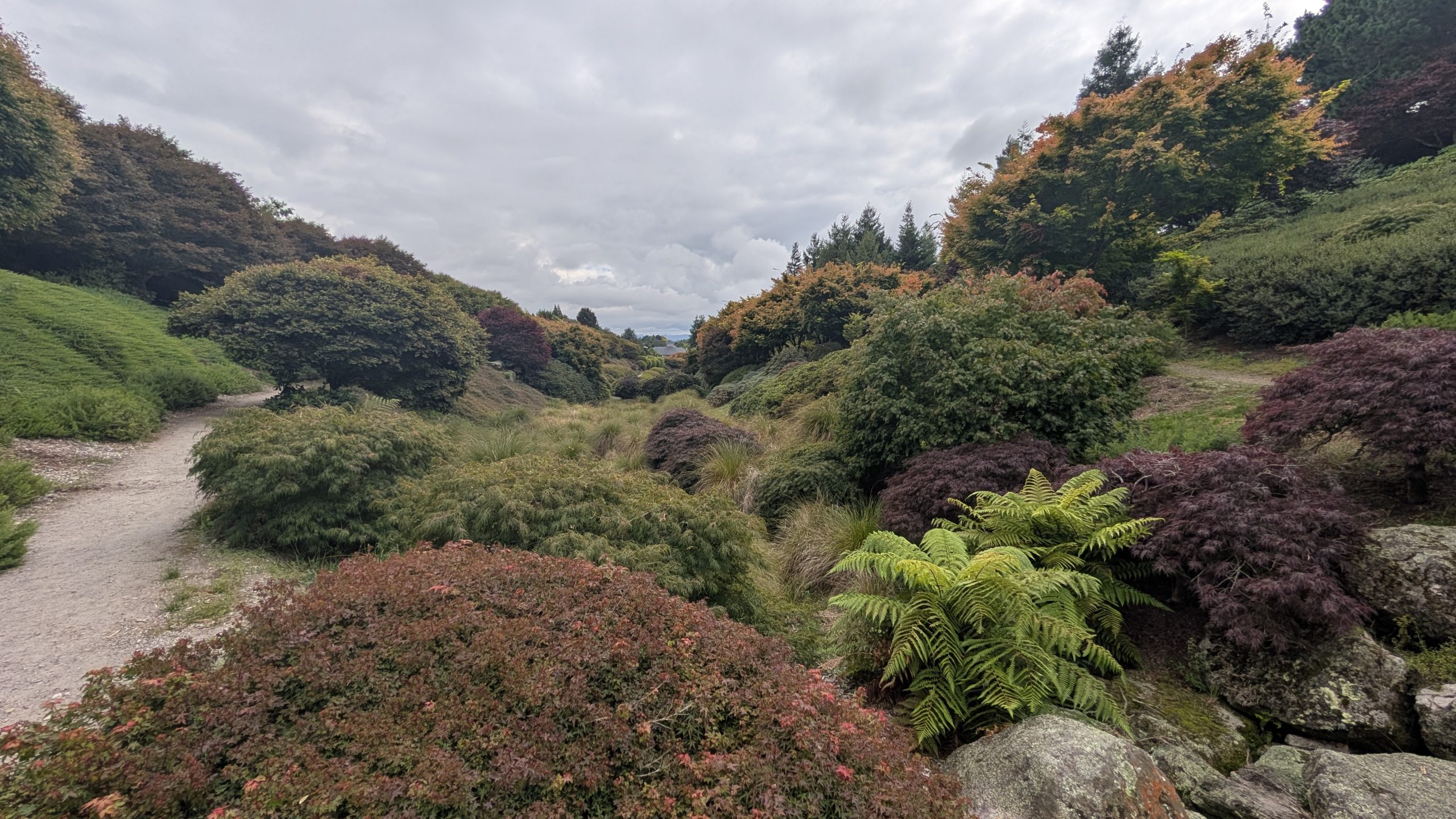
Penguin viewing platform and view across the channel
We drove back to the house for lunch. I walked back down to the beach, and now there were two sea lions resting at the same spot where I had seen the one earlier.
Sea lions on Ta Rauone BeachTa Rauone Beach with distant view of the sea lionsPretty flowers at the beach houseMore pretty flowers
The entrance to the OPERA (Otago Peninsula Eco Restoration Alliance) was directly across the street from our beach house, and we had booked the 3 PM tour. This was a 1.5 hour tour through a preserve where yellow-eyed and little blue penguins were nesting, and it was also a rehabilitation center for sick, injured, or malnourished penguins.
Entrance road to the OPERAHarbor view from the OPERA tour entrance
There were 19 people in our tour group. The first part of the tour was a presentation and video about the preserve and the penguins that lived there. Then we split into two groups. Heinrich and I were in a group of 10. We boarded a bus that drove us through the preserve. Then we took a trail out to where penguins were nesting in the wild. We walked to hides where we were able to watch 4 yellow-eyed penguins. They were in the moulting stage where they were growing new feathers and unable to go into the ocean to feed. They were resigned to staying in their nesting area until the new feathers grew in. They were standing around and looking rather miserable.
Moulting yellow-eyed penguinA group of 3 moulting yellow-eyed penguins
We had about 5 to 10 minutes to view the moulting penguins, and then we had to leave for the next group to visit. We continued the walk down to a view of the beach area. We were given binoculars to see if we could find any yellow-eyed penguins in the area, but we didn't see any.
Penguin beach area
Further down the walk we passed some wooden enclosures where the little blue penguins were nesting. We saw one sitting inside.
Little blue penguin sitting inside the enclosure
We walked back to the bus and were driven back to the entrance. We walked to the penguin rehabilitation center. We were able to view about 25 penguins of different species. I got my very first close-up view of fiordland crested penguins.
Yellow-eyed penguins at the rehabilitation center
More yellow-eyed penguinsYellow-eyed penguin at the pondAnother pair of penguinsFiordland crested penguins
I thought it was a good tour, but I wish I had more time to view the penguins. It seemed rushed.
After the tour we drove back to the beach house and had dinner. The new propane tank had been delivered, so we were able to use the grill for our steaks.
Steak dinner at the beach house
After dinner I walked down to the beach again, and now there were three sea lions onshore. I had some more fun viewing them. The calm weather had disappeared and now it was quite windy.
Sea lion, part 1
Sea lion, part 2Three sea lions on the beach
We spent the rest of the evening relaxing and enjoyed the hot tub.
We got up very early since we had reservations for the 0800 ferry sailing back to Bluff. On the walk to the ferry terminal I took some final pictures of Stewart Island. The weather was nice with partly cloudy skies.
South Sea Hotel annex building Halfmoon Bay view from the South Sea HotelFront of South Sea HotelFerry dockOur ferry boat with luggage getting loaded
The ferry ride across Foveaux Strait was not quite as bouncy as on the way out, but there was still a fair amount of wind. The weather deteriorated and it was raining and windy at Bluff when we arrived. So we left the area quickly.
We drove back to Dunedin where I had reservations for two nights at an AirBnb house located on the Otago Peninsula. I had booked it months ago with the plan to go on the Blue Penguins Pukekura tour while we were there since it was only a few miles away at the end of the road. But when I went to reserve the tour, it was completely full for those nights. This was why we stayed in Dunedin earlier on February 13: it was the only date I was able to find that was still open for seeing the penguins. Now we were returning so that we could explore the other areas on the Otago Peninsula close to where we would be staying.
The weather rained off and on for the first couple of hours of the drive. But it improved as we drove further north. By the time we reached the town of Gore it was partly cloudy. We stopped at a bakery in Gore to buy a few treats and a couple of steak and cheese pies for lunch.
Big fish statue in the town of Gore
We ate our pies at a local park and then continued driving to the town of Balclutha. We stopped at the Arthur Strang Reserve at the edge of the Clutha River to eat our bakery treats.
State Highway 1 bridge over the Clutha River, view from Arthur Strang ReserveCarrot cake muffinEating our treats at the Arthur Strang Reserve
We drove on into Dunedin where we stopped at the PAK 'n SAVE store at the edge of town to buy groceries for the new few days. Then we drove the rest of the way to the Otago Peninsula and our AirBnb rental.
The rental was a house with windows overlooking the Otago Harbour. At the rear of the house was a path that led directly to Te Rauone Beach. It was very peaceful and quiet with beautiful views. Best of all, the back yard contained a hot tub that we were free to use.
View from the upstairs bedroomTe Rauone BeachBack yard with hot tub
The AirBnb rental had advertised there was a propane grill that we could use, so at the PAK 'n SAVE grocery store we had purchased some steaks and pork chops to grill. But when we tried to start the grill we found out it was out of propane. I contacted the owner of the AirBnb and she said she would not be able get us a new tank until the following day. So we ended up using the electric fry pan for our pork chop dinner.
Dinner: fried pork chop, brown rice with salsa, and cinnamon applesauce
Today was a free day for us to explore Stewart Island since we had no paid tours planned. We considered renting bikes to tour the island but decided against it since some of the places that I wanted to visit were on hiking trails. The weather forecast looked decent until about 3 pm when a band of rain showers was expected.
We allowed ourselves to sleep in after the late return from the kiwi spotting tour last night. We walked over to the hotel restaurant and had a real sit down breakfast.
Fisherman's Breakfast with local smoked fish, hash browns, and a fried egg
After breakfast we decided to take the walk to Ackers Point. This walk followed the southern coastline of Halfmoon Bay to a scenic lookout. The first part of the walk followed the road which had many scenic views of beaches and bays.
Starting the walk southwest from town with views of Halfmoon BayHalfmoon Bay with the town of Oban and the ferry terminal in the distance
We passed Lonnekers Beach which was at low tide, so we walked across the beach.
Lonnekers BeachLonnekers Beach looking southLonnekers Beach looking north
Continuing up the road we passed Leask Bay which was a private area for the locals and their boats.
Leask Bay
Past Leask Bay we climbed the road to a nice view of Halfmoon Bay. The photo below shows the beaches and coastline on the far side of the bay where I would take a hike later that afternoon.
Halfmoon Bay with Butterfield Beach, Bragg Bay, and the trail to Horseshoe Point in the distance
The road ended at Ackers Stone House which we would explore later on our return. We took the hiking trail that climbed up to Ackers Point. The weather had been sunny for the start of our walk but then steadily got cloudier, and by the time we reached Ackers Point it was completely cloudy and appeared to be raining in the distance. We could see many of the islands in the Foveaux Strait.
Ackers PointBench Island view from Ackers Point, where we saw the yellow eyed penguins the previous day
On the return walk we stopped at Fisherman Point where we saw many sea birds doing their own fishing.
Side trail to Fisherman Point
Birds at Fisherman PointWhite-fronted terns resting on the rocks at Fisherman Point
Back at the head of the trail we stopped to see Ackers Stone House, which is the oldest European building on Stewart Island and a New Zealand historic place. Lewis Acker was an American whaler who built the house around 1836 and raised nine children.
Ackers Stone HouseInside the houseView from the opposite end of the houseHarrold Bay, located behind the house
We walked back to our room and had lunch. Heinrich was done walking for the day, but I wanted to see more, so in the afternoon I decided to hike to Horseshoe Point which was southeast of Oban and had views of the Foveaux Strait and Horseshoe Bay.
I followed the same route I had taken on the first day past Bathing Beach, and I continued on Horseshoe Bay Road to Butterfield Beach.
Butterfield Beach
Past Butterfield Beach I walked up Bragg Bay Road, which was a gravel road. I stopped to see the Moturau Moana Native Gardens. I climbed a short trail to a nice viewpoint of Halfmoon Bay.
Halfmoon Bay view from Moturau Moana Native Gardens
Next I explored the paths through the gardens. The area is New Zealand's southernmost public garden and was gifted to the government by Noeline Baker in 1940.
Path to Fern GullyMany native fernsPretty plants and treesGarden view
I walked back to the gravel road. The Horseshoe Point track started at the end of the road at Bragg Bay.
Bragg Bay
The track climbed uphill past a small cemetery and then wound around many little coves, going up and down. It was slow going, and the weather had started to deteriorate with the predicted rain starting shortly before 3 pm. Fortunately I had my rain gear and it was only a light drizzle off and on.
One of the coves along the Horseshoe Point track
The trail descended steeply with many steps down to Dead Man Beach, which was very pretty. It was raining a bit harder now.
Dead Man Beach view from aboveView past Dead Man Beach
The trail climbed uphill past the beach, but it was not nearly as steep on that side. I continued to climb gradually higher on the trail until finally I reached Horseshoe Point. By this time it was raining even harder, and I was very thankful for my rain gear. I did not stay very long at the point since it was raining, windy and generally miserable conditions. Timing is everything!
Horseshoe PointHorseshoe Bay view from Horseshoe Point
I continued on the trail, descending down gradually to Horseshoe Bay. It continued to rain steadily. Fortunately the downhill trail was much easier than going up. It ended at Horseshoe Point Raod, which was a dirt road that followed the shore of Horseshoe Bay. At the start of the dirt road was a funny sign.
Watch out for Big Foot
Finally I reached the end of the dirt road where it intersected with the main Horseshoe Bay Road. I was able to follow the main road about 2 miles all the way back to town.
Horseshoe Bay view from the main road
It continued to rain steadily as I walked along the main road, and finally the rain let up just as I approached town. The sun came out and there was a rainbow. By the time I reached town there were actually patches of blue in the sky.
Rainbow at the ferry terminalA few minutes later with nicer weather
I went back to the room and dried out. My boots and socks were soaked. After changing into dry clothes, I walked over to the hotel restaurant with Heinrich to eat dinner. It was a nice evening with partly cloudy skies.
Heinrich's dinner: salmon, fish of the dayMy dinner: salmon pizza
After dark I ventured out one more time, hoping to spot a kiwi on my own. I had brought a small red flashlight which I soon discovered was not nearly bright enough to be of much use. I walked to Traill Park. I had been told this was a good place to look since it has a large grassy field that kiwis like for finding worms to eat. Apparently I wasn't the only person with this idea since I ran into a few others with red flashlights.
While I was in the park, I looked up and saw stars! It looked almost completely clear. Too bad there was no aurora. But the nice weather was short lived. 15 minutes later it started drizzling rain.
My search for kiwi was in vain, and I decided to head back to the room. I was looking for the Fuchsia Walk which should have brought me back close to the hotel. Somehow I got turned around and ended up on the Raroa Walk which headed in the opposite direction toward Golden Bay. I didn't realize my mistake until I got all of the way to the end of the trail and saw the signs to Golden Bay. I followed the main road back to the hotel, which was a 20-minute walk from there. Another late night out.
Our first full day on Stewart Island was packed with activities. It rained overnight and we woke up to an overcast morning. But the weather forecast looked good for it to clear in the afternoon.
We walked over to the local bakery and bought some treats. This was also one of the places where we could reserve a sea shuttle to take us to the nearby Ulva Island. We reserved the 10:30 am shuttle and scheduled a return time of 3 pm.
Carrot cake treat at the bakery
The shuttle left from the Golden Bay wharf which was about a 20-minute walk from our room. We had over an hour to spare, so we took the scenic route via a couple of trails (Fuchsia Walk and Raroa Reserve Track) through the forest to get there.
Big tree on the Fuchsia Walk
Trail to Golden Bay Beach
Golden Bay Beach. The wharf is on the right.
The sea shuttle met us promptly at 10:30 am. It was a quick 8-minute ride to Ulva Island. Our plan was to hike the entire network of trails on the island. Ulva is a predator-free island, so there is a large variety of birds and native plant life with minimal introduced species.
Trail signs near the wharf showing our options
We decided to hike to Boulder Beach. The goal was to take our time and look for various birds. The trail was very easy: flat most of the way. I am not a big bird watcher, but I have to admit I really had fun walking the trails. And we saw and heard quite a variey of of birds. Our first sighting was a kaka. This is a parrot that is considered to be threatened in many areas but is common on Ulva, so we felt lucky to have such a good view.
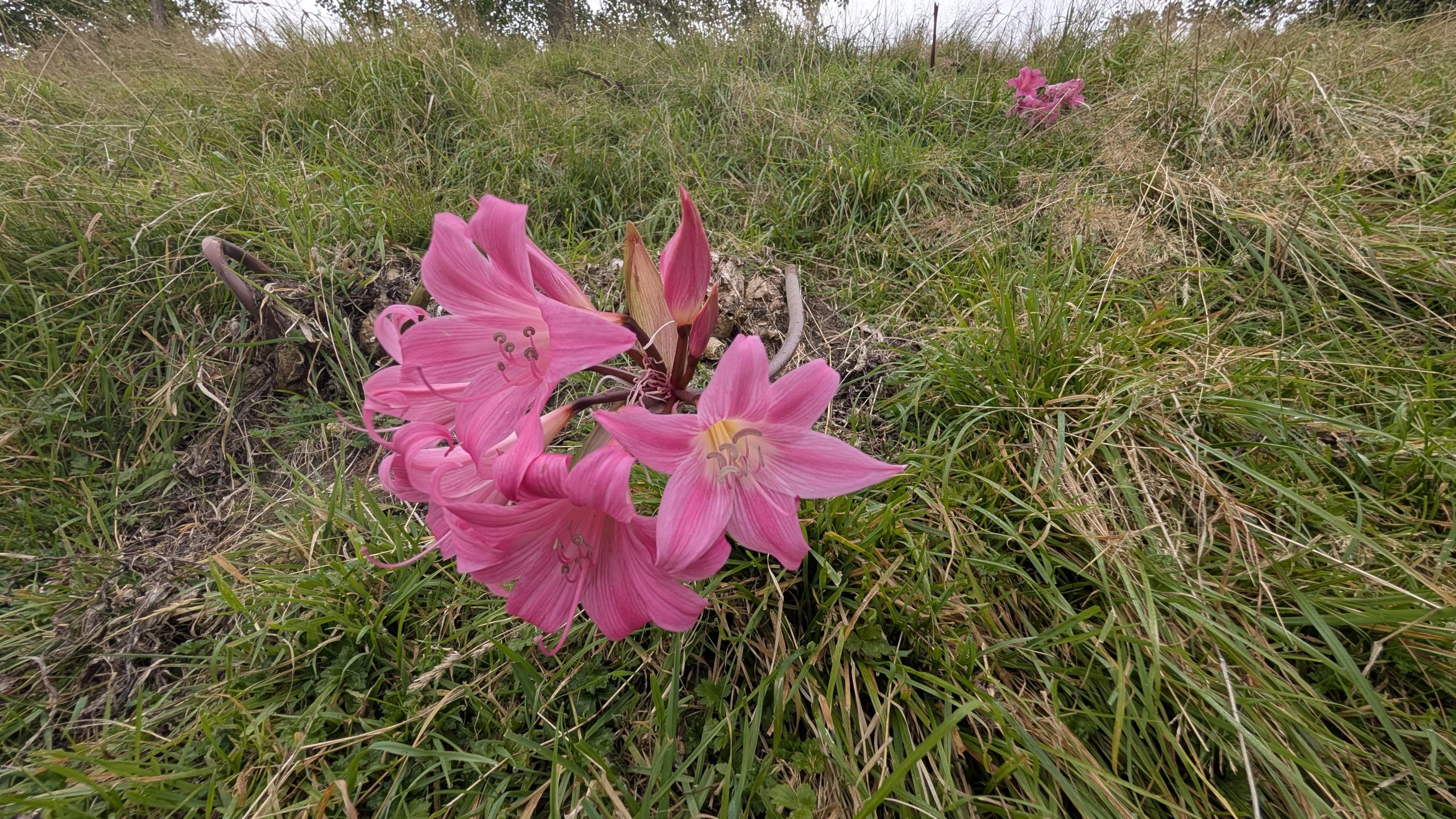
Kaka
We arrived at Boulder Beach and had a water and snack break. We saw several oystercatchers running around on the beach.
Boulder BeachOystercatcher (torea)
Next we took the trail to West End Beach. By the time we arrived, the weather had cleared and it turned into a beautiful afternoon.
West End BeachView from West End Beach
On the right hand side of the beach was a little sea cave that I explored. It was really just a big overhang and not a cave, but it was interesting. On the way back from the cave I saw three weka birds: two adults and a young one.
Sea cave at West End Beach
Juvenile weka bird at West End Beach
We turned around and started walking to the other side of the island at Sydney Cove. This was yet another pretty forest walk. We saw a few more interesting birds along the way, and we heard the calls from the kaka birds, but we did not see them.
Trail from West End Beach to Sydney CoveStewart Island robin (toutouwai)
New Zealand parakeet (kakariki)
We had almost reached the cove when we saw a couple of people ahead of us, staring into the forest. They excitedly whispered to us: kiwi! And sure enough, a large adult kiwi was grazing just to the side of the trail. After a few minutes it crossed the trail and then was grazing for several minutes on the other side. It seemed entirely unfazed by our presence. We watched it for about 20 minutes before it finally disappeared into the woods. This was the icing on the cake for me, to see a kiwi in broad daylight.
Kiwi crossing the trail
Kiwi at the side of the trail
Kiwi continuing to graze
We continued on the trail down to the beach at Sydney Cove. Then we followed the path across the beach to the next short trail up to Flagstaff Point which had nice views of the area.
Sydney CoveFlagstaff Point
From Flagstaff Point it was just a 5-minute walk back to Post Office Cove Wharf where we would meet the sea shuttle to return us to the main island. Since it was still a little early for the boat, I walked back to Sydney Cove and saw a sea lion swimming in the water close to shore.
Sea lion swimming at Sydney Cove
The water taxi arrived shortly before 3 pm, and we took the quick jaunt back to the wharf at Golden Bay. The experience on Ulva Island greatly exceeded my expectations. Even before we found the kiwi, it was a really fun day walking around on the trails. The bird sounds were prolific, and the native forest was beautiful.
Sea shuttle at Post Office Cove Wharf
We took the 20-minute walk back to our room, and then we walked over to the hotel restaurant for an early dinner.
Potato wedges and bacon ordered from the bar menu
At 7:30 pm it was time for our next adventure: the Wild Kiwi Encounter tour with RealNZ. This was a 4 to 5-hour tour that started with a boat cruise around some of the outlying islands and ended with a walk on the trails in Glory Cove, the southernmost point we've ever been, to search for kiwi. During the boat cruise portion of the tour we would look for other wildlife: penguins, sea birds, fur seals, and sea lions.
Map: Day 27 (wildlife cruise and kiwi spotting)
The tour left from the ferry terminal and used the same boat that had ferried us over from Bluff. There were 19 total people on the tour plus 2 guides, so the boat was very uncrowded.
Start of the wildlife cruise
The boat passed an island where we were able to view a Fiordland crested penguin standing outside a little cave. The guide told us that the penguin was probably moulting. This is the stage during the year when the penguins shed their feathers and grow a new set, and during that time they are unable to go in the water since they lose their waterproofing. For a couple of weeks they must stay onshore. Although the penguin was a bit far away, I was able to get a photo. This was my very first sighting of this type of penguin.
Fiordland crested penguin
Next we passed by Bench Island where we were hoping to see some of the yellow eyed penguins in the water or onshore, but we didn't see any. The boat continued on to an area where we were able to see a group of fur seals hunkering down on the rocks. They are hard to pick out in the next photo: look for the darker black objects on the left side that resemble rocks.
Fur seals resting on the rocks
The boat circled back to Bench Island for a second attempt at the penguins. This time we found them: three hoiho were standing on the rocks near the shore. They didn't move around much and just stood there the entire time that we watched them.
Three yellow eyed penguins at Bench Island
Penguin video
Our next stop was a rocky island where hundreds of shag birds were resting.
Many shags
Near our stop at Glory Cove was a beach where many sea lions were hanging out.
Sea lions on the beach
The boat docked at Glory Cove, and we got ready for the kiwi spotting portion of the tour. First we listened to a talk from the guide on what to expect. The rules for the hiking portion of the tour were much stricter than what we had encountered with Beaks and Feathers. We were to walk single file at all times and make as little noise as possible. We were not allowed to take our backpacks with us. We each received a flashlight that we used to point down at our feet at all times: enough light to see where we were going. We were split into two groups: Heinrich and I were in the first group of 10 with our guide. I was at the front of the line. Shortly after we got off the boat and started the walk uphill, the guide turned around and asked me what I was wearing. Apparently my rain pants were making too much noise, and she asked me to take them off. Fortunately I had two more layers underneath and it was not raining! She slung my rain pants over the railing and said I could pick them up when we returned to the boat.
We walked about 20 minutes when the guide spotted an adult kiwi close to the trail. It was a very good viewing with the kiwi not bothered by our presence, and everyone in the group was able to get a good view of it. We watched it for about 20 minutes, and it was still there when the guide said we had to move on.
Kiwi at Glory Cove
After about another 10 minutes of walking, the guide spotted another kiwi. It was a juvenile and was very actively moving around. I was not able to get any good photos of it, but we watched it for about 5 minutes before it moved out of sight.
For the second half of the hike, the guide had us switch places so I was now at the very back of the line. But that turned out okay since we did not see any more kiwi. We returned to the boat, I retrieved my rain pants, and then we settled in for the half hour ride back to the ferry dock.
It was after midnight when we returned. I thought it was a good tour and interesting to compare it with the Beaks and Feathers kiwi experience where the spotting rules were more relaxed. I think that is due to so many kiwi on the Beaks and Feathers tour that we were almost guaranteed to see at least one, where with the RealNZ tour it required more luck to see at least one, and some of the tours might not get to see any.